
Gasoline Octane Ratings: Regular, Mid-Grade, and Premium Compared

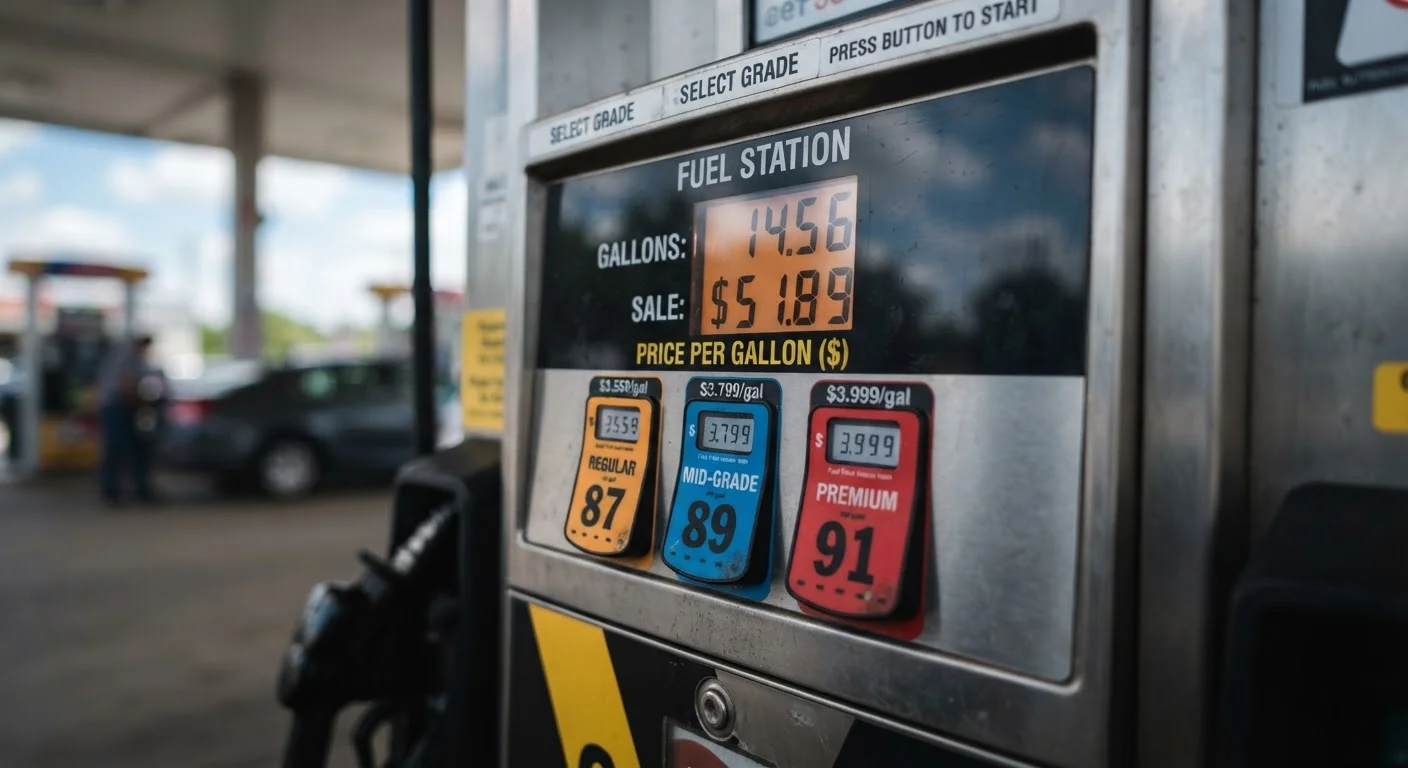
Photo: TheSearchHound.com | One Stop Answer To All Your Questions editorial
Key Takeaways
- Octane ratings measure a fuel's resistance to premature combustion, not its energy content or quality.
- Most everyday vehicles are engineered to run optimally on regular 87-octane fuel.
- Using premium in a car designed for regular generally provides no measurable benefit.
- Engines that require premium fuel can experience knock and long-term damage without it.
- Mid-grade occupies a middle ground that few modern vehicles actually need.
What Octane Actually Measures
The number on the pump - 87, 89, 91, or 93 - is an AKI rating, the average of two lab measurements that together gauge how resistant a fuel blend is to engine knock (also called detonation or pre-ignition). Engine knock happens when the air-fuel mixture in a cylinder ignites before the spark plug fires, creating an uncontrolled pressure spike. Left unchecked, persistent knock can erode pistons and damage engine components over time.
Critically, octane is not a measure of fuel energy, cleanliness, or quality in a general sense. A gallon of 93-octane and a gallon of 87-octane contain nearly identical energy content. The difference is purely in combustion stability under pressure.
~90%
U.S. vehicles designed for regular fuel
The U.S. Energy Information Administration has consistently reported that the large majority of American passenger vehicles are rated for regular-grade gasoline.
87
Standard regular octane rating (AKI) in the U.S.
The AKI system averages two lab test results (RON and MON) and is the rating displayed on every U.S. fuel pump by federal requirement.
How Each Grade Is Used - and By Whom
Regular (87 AKI) is the correct choice for the vast majority of passenger cars, trucks, and SUVs sold in the United States. Modern engines are calibrated with compression ratios and ignition timing tuned specifically to run on 87-octane. Using a higher grade in these engines will not increase power or fuel economy in any meaningful way.
Mid-Grade (89 AKI) was historically recommended for some naturally aspirated engines with moderate compression ratios. Today, very few new vehicles specify it, and it tends to be purchased out of habit or a sense of compromise rather than engineering necessity.
Premium (91-93 AKI) is formulated for high-compression engines - found in many performance vehicles, turbocharged engines, and some luxury models - that generate enough cylinder pressure to trigger knock on lower-octane fuels. For these engines, premium is a mechanical requirement, not a luxury upgrade. Many manufacturers distinguish between required and recommended premium; "required" means the engine needs it, while "recommended" suggests the engine can adapt but may perform better with it.
| Regular (87) | Mid-Grade (89) | Premium (91-93) | |
|---|---|---|---|
| Knock Resistance | Standard | Moderate | High |
| Typical Price vs. Regular | Base price | ~$0.10-0.15 more/gal | ~$0.20-0.40 more/gal |
| Vehicles That Need It | Most cars, trucks, SUVs | Very few modern vehicles | High-compression, turbo, performance engines |
| Performance Boost in Wrong Engine | N/A (baseline) | Negligible | None in regular-spec engines |
| Risk of Using Lower Grade | None (it's the base) | Minimal in most cases | Knock, power loss, potential long-term wear |
| Where Spec Is Listed | Fuel door / manual | Fuel door / manual | Fuel door / manual |
The Role of Knock Sensors and Engine Management
Modern engines include knock sensors that detect pre-ignition and instruct the engine control unit (ECU) to retard ignition timing in response. This means an engine designed for premium can technically run on regular without immediate damage - but with reduced power output and, in some cases, lower fuel efficiency. Over extended periods, consistently under-fueling a high-compression engine in this way may stress components beyond design tolerances.
Conversely, putting premium in an engine built for regular does not allow the ECU to unlock hidden performance. The engine's mapping was never designed to take advantage of greater knock resistance, so the extra cost produces no benefit.
Check Your Fuel Door First
How to Know What Your Car Needs
The definitive answer is always in two places: the inside of the fuel filler door and your vehicle's owner's manual. Manufacturers are required to state fuel grade requirements clearly. If your door says "87 Octane" or "Regular Unleaded," that is what the engineers designed and tested for. If it says "Premium Fuel Required" or "91 Octane Minimum," that is a specification, not a suggestion.
Altitude is one nuance worth noting: octane ratings are standardized at sea level, and some older vehicles may run more smoothly on a slightly higher grade at high elevations where air is thinner - but modern fuel management systems largely compensate for this automatically.
The bottom line is straightforward: follow the manufacturer's specification. Doing so protects your engine, keeps your fuel budget predictable, and ensures your vehicle performs as designed. There is no engineering case for routinely exceeding the specified grade.
The content on this site is provided for informational purposes only and should not be considered a substitute for professional advice. While we strive to provide accurate and up-to-date information, we make no guarantees regarding its completeness or accuracy. Always consult a qualified professional for advice specific to your circumstances before making any decisions.