
Diversification in Plain English

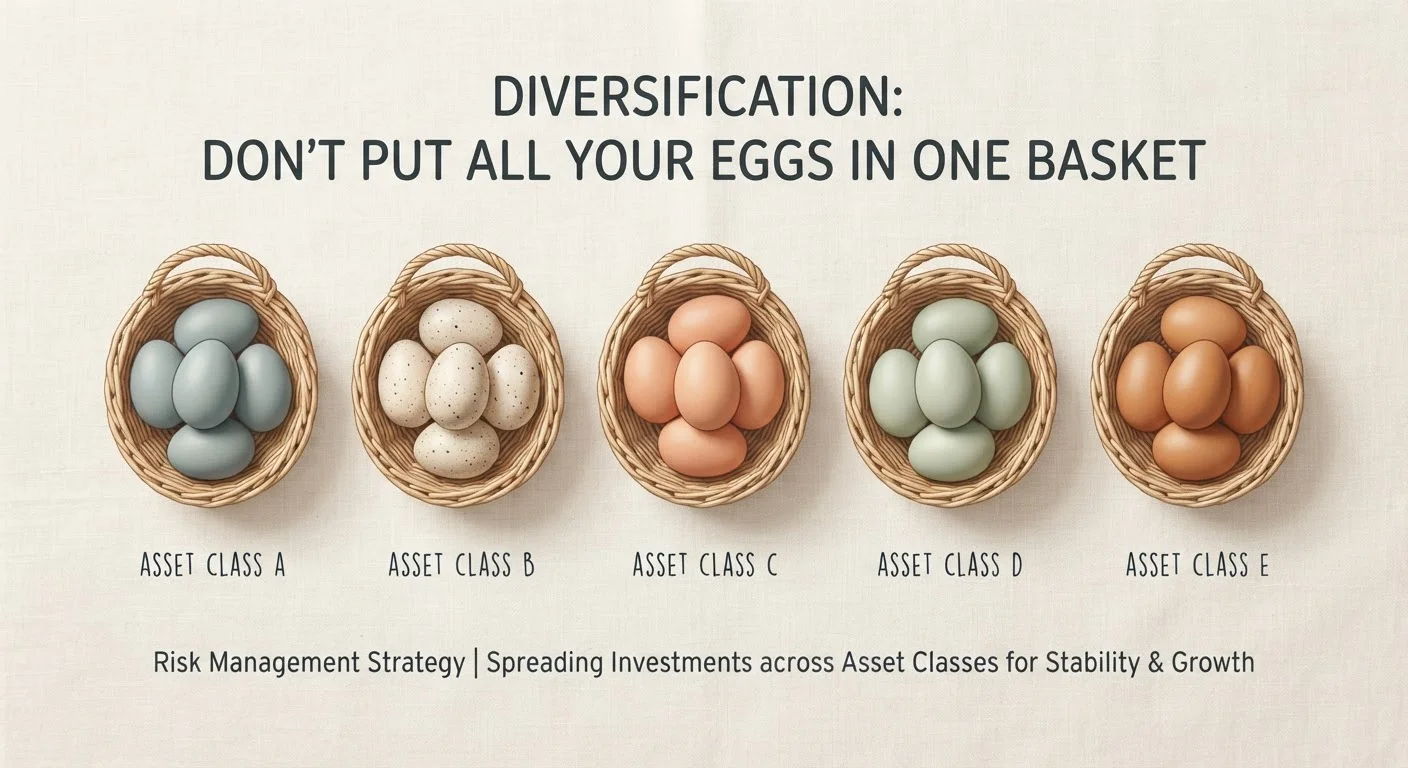
Photo: TheSearchHound.com | One Stop Answer To All Your Questions editorial
Key Takeaways
- Diversification spreads money across multiple investments to reduce the impact of any single loss.
- It manages a specific type of risk - company or sector-specific - but cannot protect against market-wide downturns.
- A diversified portfolio can include a mix of stocks, bonds, and other asset types.
- Even simple, low-cost investment funds can provide broad diversification automatically.
- Diversification is not a guarantee of profit, but it is a widely accepted risk-management tool.
The Core Idea: Don't Put All Your Eggs in One Basket
Most people have heard the phrase, but diversification is more than folk wisdom - it's a foundational principle of investing. If you place all your money into a single company's stock and that company struggles, your entire investment suffers. Spread that same money across dozens of companies, and one bad outcome becomes a smaller fraction of the whole.
This matters because individual investments are unpredictable. Even well-managed companies face setbacks: industry shifts, regulatory changes, or broader economic pressures. Diversification doesn't require you to predict which investments will win - it simply ensures that no single outcome can derail your financial picture. To understand why this is central to investing, it helps to first understand what investing actually involves.
~1,000+
Securities in a typical broad-market index fund
Total market index funds commonly hold exposure to more than a thousand individual stocks, providing wide diversification through a single investment vehicle.
Lower volatility
Effect of diversification on portfolio swings
Academic research in modern portfolio theory, established by economists including Harry Markowitz, consistently shows that combining assets with low correlation reduces overall portfolio volatility.
What Diversification Actually Protects Against
Diversification targets a specific kind of risk: the risk that is unique to a single company, industry, or region. Financial professionals sometimes call this unsystematic risk. When one company reports a poor earnings quarter, a well-diversified investor feels only a small ripple rather than a full wave.
However, there's a limit. Diversification cannot shield a portfolio from systematic risk - the kind of broad market decline that affects nearly all investments simultaneously, as seen during major recessions or financial crises. During those periods, even diversified portfolios typically lose value. Understanding this distinction is important: diversification is a tool for managing concentration risk, not a way to avoid all market volatility.
Diversification Has Real Limits
How Diversification Works in Practice
A diversified portfolio typically spreads money across several dimensions at once. The most common are:
- Asset classes: Holding a mix of stocks, bonds, and possibly other asset types means that when stocks fall, bonds may hold steadier. See our plain-language breakdown of stocks, bonds, and funds for how each type works.
- Industries and sectors: Owning shares across technology, healthcare, energy, and consumer goods means a downturn in one sector doesn't dominate the entire portfolio.
- Geographies: Including international investments alongside domestic ones can reduce exposure to any single country's economic conditions.
For many everyday investors, broad-market index funds handle much of this automatically - a single fund may hold hundreds or thousands of securities across sectors and regions. Pairing a diversification approach with a strategy like dollar-cost averaging can further reduce the impact of market timing on your portfolio.
Common Misconceptions Worth Clearing Up
One frequent mistake is confusing the number of investments with the breadth of diversification. Owning fifteen different technology stocks may feel diversified, but if all fifteen move together - up or down - the portfolio behaves like a single concentrated bet on one industry. True diversification requires holdings that don't all respond identically to the same events.
Another misconception is that diversification is only for large portfolios. In reality, even investors just starting out can access diversified exposure through low-cost funds available in employer-sponsored retirement plans or individual brokerage accounts. For unfamiliar terms along the way, our investing glossary covers 30 essential concepts in plain language.
This article is for general informational and educational purposes only and does not constitute personalized financial or investment advice. Consult a qualified financial professional before making decisions about your own portfolio.
Frequently Asked Questions
The content on this site is provided for informational purposes only and should not be considered a substitute for professional advice. While we strive to provide accurate and up-to-date information, we make no guarantees regarding its completeness or accuracy. Always consult a qualified professional for advice specific to your circumstances before making any decisions.