
Index Funds vs. Actively Managed Funds: What the Difference Means for You

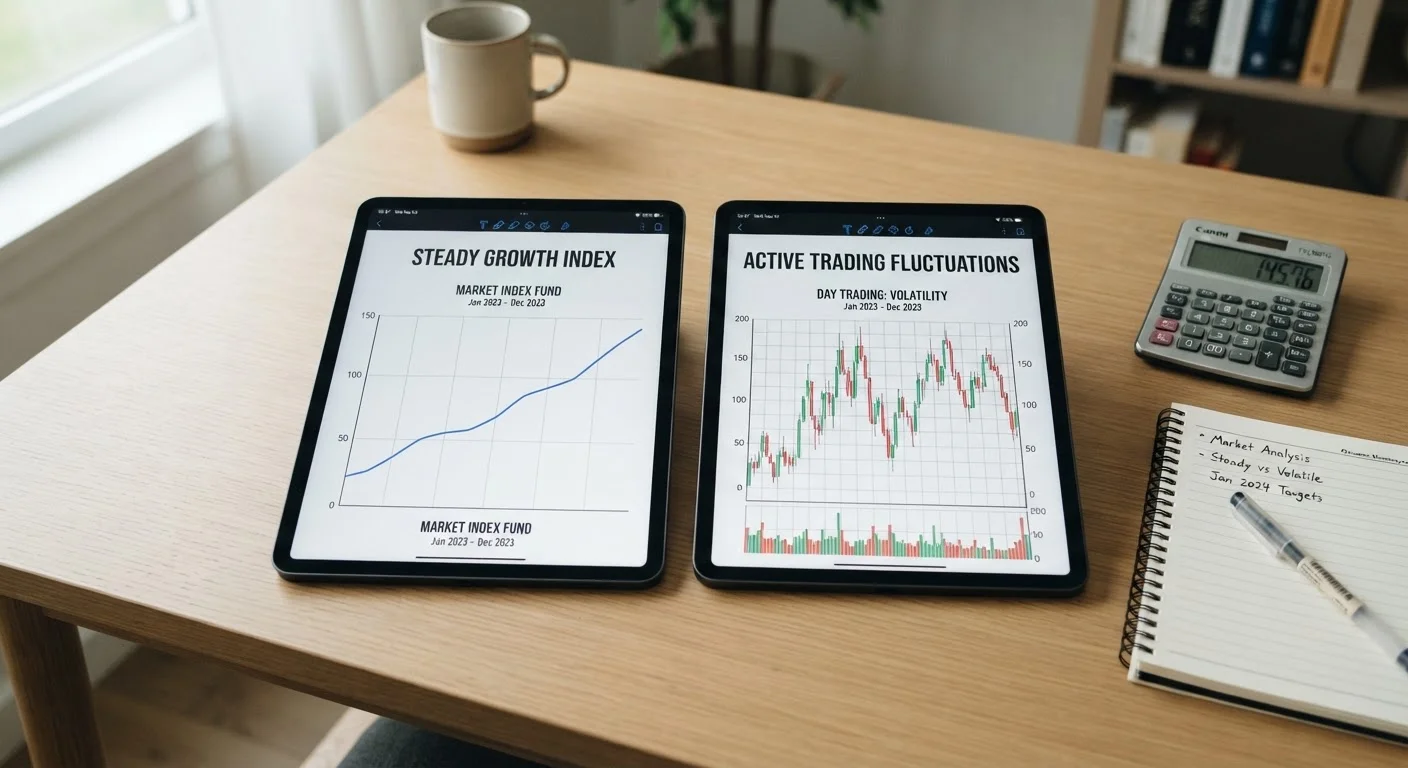
Photo: TheSearchHound.com | One Stop Answer To All Your Questions editorial
Key Takeaways
- Index funds passively track a market benchmark, keeping costs very low for investors.
- Actively managed funds employ professional managers who make deliberate buy-and-sell decisions, typically at higher cost.
- Research consistently shows most actively managed funds underperform their benchmark index over the long run.
- Expense ratios are a critical factor - even a small fee difference compounds significantly over decades.
- Neither approach is universally superior; your goals, timeline, and risk tolerance all matter.
- Consulting a licensed financial adviser can help you determine which approach fits your personal situation.
How Each Fund Type Actually Works
Before comparing outcomes, it helps to understand the mechanics. If you're new to investing altogether, our primer on what investing means lays the foundation clearly.
An index fund is designed to replicate the performance of a specific market index - such as the S&P 500, which tracks 500 large U.S. companies. The fund holds the same securities as the index, in roughly the same proportions. There's no team of analysts deciding what to buy or sell; the portfolio simply mirrors the benchmark. This passive approach keeps trading activity low and management overhead minimal.
An actively managed fund, by contrast, employs a portfolio manager - sometimes a full team - who researches securities and makes deliberate decisions about what to own, when to buy, and when to sell. The stated goal is to outperform a benchmark index, not just match it. Managers might focus on a sector, a market cap range, or a specific investing philosophy. That human judgment and research infrastructure costs money, which is passed on to fund investors.
| Criterion | Index Funds | Actively Managed Funds |
|---|---|---|
| Management approach | Passive - tracks a benchmark | Active - manager selects securities |
| Typical expense ratio | 0.03%-0.20% | 0.50%-1.00%+ |
| Trading frequency | Low - changes only when index changes | Higher - driven by manager decisions |
| Goal | Match market returns | Beat a benchmark index |
| Tax efficiency | Generally higher | Can be lower due to turnover |
| Long-term track record (most funds) | Matches market consistently | Most underperform after fees |
| Complexity for investor | Low - minimal decisions needed | Higher - requires evaluating managers |
The Cost Gap: Why Fees Matter More Than They Seem
The most consequential difference between these two fund types isn't a matter of philosophy - it's cost. Every fund charges an expense ratio, expressed as an annual percentage of your invested assets. For index funds, expense ratios are typically very low, often between 0.03% and 0.20%. Actively managed funds frequently charge 0.50% to 1.00% or more.
~88%
Active large-cap funds underperforming over 15 years
According to S&P Dow Jones Indices' SPIVA U.S. Scorecard, roughly 88% of actively managed large-cap U.S. equity funds underperformed the S&P 500 over a 15-year period.
0.03%
Lowest common index fund expense ratios
Some broad market index funds now carry expense ratios as low as 0.03% annually, compared to industry averages for active funds that can exceed 0.70%.
$30,000+
Estimated fee impact over 30 years
On a $50,000 portfolio, the compounding difference between a 0.05% and a 1.00% annual fee can exceed $30,000 in lost growth over a 30-year horizon, assuming a 7% annual return.
That gap may look trivial on paper, but compounding transforms it. On a $50,000 portfolio growing at 7% annually over 30 years, the difference between a 0.05% and a 1.00% expense ratio can amount to tens of thousands of dollars in lost returns - money that would otherwise have stayed in your account. Fees don't just reduce returns in the year they're charged; they reduce the base on which future gains accumulate.
Active funds can also generate higher taxable events through frequent trading. When a fund sells a security at a gain, those gains may be distributed to shareholders and taxed - an additional cost not captured in the expense ratio alone. This is worth considering if you're investing in a taxable brokerage account rather than a tax-advantaged account like an IRA or 401(k). For a broader look at how account type intersects with strategy, see our overview of investment account types.
What the Research Generally Shows
One of the most consistent findings in academic and industry research on investing is that the majority of actively managed funds underperform their benchmark index over long time periods, particularly after fees are deducted. The S&P Indices Versus Active (SPIVA) scorecards, published regularly by S&P Dow Jones Indices, have tracked this comparison across fund categories and time horizons for many years. The data repeatedly shows that most active managers do not sustain outperformance over 10- or 15-year periods.
This doesn't mean active management never adds value. Research does suggest that some narrower or less-efficient market segments - smaller companies, certain international markets - may offer more opportunity for skilled managers to identify mispriced securities. But identifying which active managers will outperform going forward is genuinely difficult, and past performance does not guarantee future results.
For investors who embrace a consistent, low-cost approach, strategies like dollar-cost averaging can complement index fund investing by removing the temptation to time the market. Meanwhile, if you're curious about the alternative of picking individual stocks rather than funds, our balanced look at individual stock investing walks through that decision honestly.
This article is for general informational and educational purposes only and does not constitute personalised financial, investment, tax, or legal advice. Past performance of any investment strategy or fund type does not guarantee future results. All investing involves risk, including the potential loss of principal. Please consult a qualified, licensed financial adviser before making investment decisions suited to your individual circumstances.
The content on this site is provided for informational purposes only and should not be considered a substitute for professional advice. While we strive to provide accurate and up-to-date information, we make no guarantees regarding its completeness or accuracy. Always consult a qualified professional for advice specific to your circumstances before making any decisions.