
Home Workouts vs. Gym Workouts: Weighing the Trade-Offs

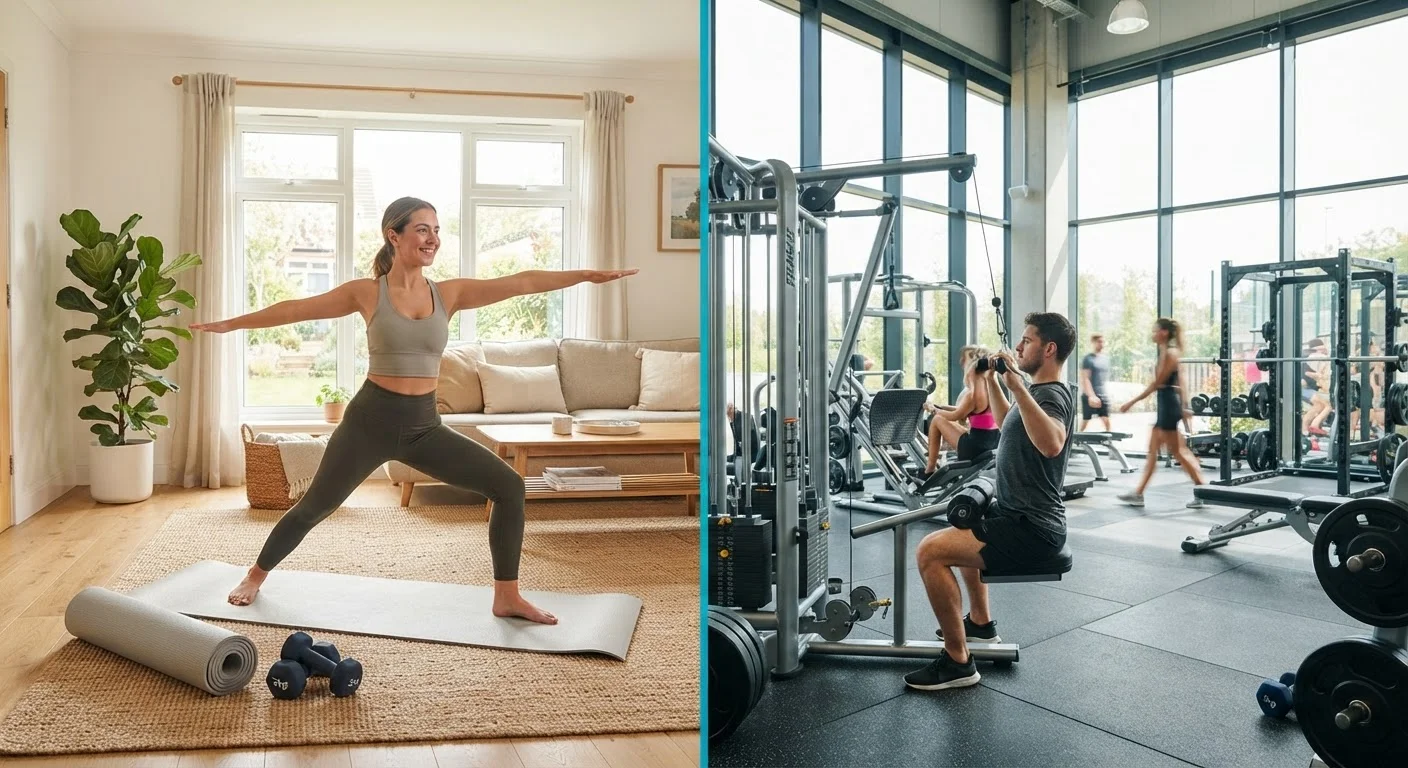
Photo: TheSearchHound.com | One Stop Answer To All Your Questions editorial
Key Takeaways
- Home workouts offer unmatched convenience and zero travel time, which helps with long-term consistency.
- Gyms provide access to specialized equipment and a structured environment that many people find motivating.
- Neither setting is universally better - the most effective option is the one you'll actually stick with.
- Hybrid approaches, combining both settings, work well for many people.
- Cost, space, goals, and personality all play a meaningful role in the decision.
No travel time or scheduling required
Eliminating the commute removes one of the most commonly cited barriers to regular exercise. Studies on exercise behavior consistently identify time as a top reason people skip workouts.
Lower long-term cost
A modest home setup - mat, resistance bands, a pair of adjustable dumbbells - represents a one-time investment that typically costs less than a year of gym membership fees.
Complete privacy and personal control
There are no wait times, no judgment, and no need to work around other gym-goers. This environment suits people who feel self-conscious exercising in public.
Flexible scheduling around daily life
Home workouts can happen before the household wakes up, during a lunch break, or after dinner - fitting into gaps that a gym visit simply wouldn't allow.
Limited access to heavy or specialized equipment
Replicating a full gym at home - barbells, cable systems, cardio machines - requires significant space and investment that most households can't practically accommodate.
Higher membership and travel costs
Monthly gym fees, plus the time and transportation cost of regular commuting, add up over a year and represent a real ongoing financial commitment.
Easier to skip without social accountability
Home workouts lack the external social cues - class start times, workout partners, visible effort of others - that help many people push through low-motivation days.
Distractions and space limitations at home
Household responsibilities, noise, limited floor space, and family interruptions can make it genuinely difficult to maintain focus during a home session.
Why Where You Work Out Actually Matters
The debate between home and gym workouts often gets framed as a question of which is more effective. But exercise science points to a more nuanced answer: the physiological demands of movement - progressive overload, cardiovascular effort, recovery - are largely the same regardless of location. What differs is the environment around those demands, and environment has a measurable impact on how consistently people exercise.
Research on exercise adherence consistently identifies convenience and enjoyment as two of the strongest predictors of long-term activity. That makes the home-versus-gym question genuinely worth thinking through - not as an abstract ranking, but as a practical fit assessment for your own life. For a broader look at how different types of movement affect your health, see our overview of strength training vs. cardio over the long run.
The Case for Working Out at Home
Home workouts remove friction. No commute, no waiting for equipment, no packing a bag - just movement when you have time for it. For people with demanding schedules or caregiving responsibilities, that reduction in barriers can be the difference between exercising and not exercising at all.
No travel time or scheduling required
Eliminating the commute removes one of the most commonly cited barriers to regular exercise. Studies on exercise behavior consistently identify time as a top reason people skip workouts.
Lower long-term cost
A modest home setup - mat, resistance bands, a pair of adjustable dumbbells - represents a one-time investment that typically costs less than a year of gym membership fees.
Complete privacy and personal control
There are no wait times, no judgment, and no need to work around other gym-goers. This environment suits people who feel self-conscious exercising in public.
Flexible scheduling around daily life
Home workouts can happen before the household wakes up, during a lunch break, or after dinner - fitting into gaps that a gym visit simply wouldn't allow.
Bodyweight exercises, resistance bands, and a modest set of dumbbells can support a full range of fitness goals, from cardiovascular conditioning to meaningful strength development. Online programming and video instruction have also dramatically expanded what's achievable without a facility. If you work a desk job and struggle to fit movement in, practical strategies for staying active without a gym may also be worth exploring.
The Case for the Gym
Gyms offer infrastructure that's difficult and expensive to replicate at home: cable machines, barbells with heavy plate stacks, rowing ergometers, climbing ropes, and dedicated stretching areas. For people pursuing specific athletic goals - powerlifting, competitive cycling, advanced hypertrophy - that equipment access is often genuinely necessary rather than just convenient.
Limited access to heavy or specialized equipment
Replicating a full gym at home - barbells, cable systems, cardio machines - requires significant space and investment that most households can't practically accommodate.
Higher membership and travel costs
Monthly gym fees, plus the time and transportation cost of regular commuting, add up over a year and represent a real ongoing financial commitment.
Easier to skip without social accountability
Home workouts lack the external social cues - class start times, workout partners, visible effort of others - that help many people push through low-motivation days.
Distractions and space limitations at home
Household responsibilities, noise, limited floor space, and family interruptions can make it genuinely difficult to maintain focus during a home session.
Beyond equipment, the gym environment itself provides structure. Dedicated training time, the presence of others working hard, and access to personal trainers or group fitness classes all contribute to motivation for people who find solo home sessions hard to sustain. If you're working toward low-impact movement, our article on what low-impact exercise actually means covers which settings and activities qualify.
Making a Decision That Sticks
A few honest questions can sharpen the choice: Do you need external accountability to stay consistent, or does self-direction work for you? Is your available space and budget compatible with a reasonable home setup? Does commuting to a gym feel energizing or like an obstacle?
~73%
Adults who cite convenience as a top exercise barrier
CDC physical activity survey data consistently identifies time and access as the leading reasons American adults fall short of activity guidelines.
2x
Relative adherence benefit of preferred exercise setting
Research published in exercise psychology literature suggests people who exercise in their preferred environment are roughly twice as likely to maintain the habit at six months.
Hybrid approaches are worth considering. Some people maintain a home routine for weekday sessions - short, convenient, consistent - and use a gym once or twice a week for heavier lifting or classes. Neither option needs to be all-or-nothing. What matters most is that the choice reduces the psychological friction between you and movement. For those who find traditional workout formats unappealing altogether, low-pressure approaches to building consistent movement may offer a useful alternative frame.
This article is for general informational purposes only and is not a substitute for personalized advice from a qualified health or fitness professional. Consult a professional before beginning any new exercise program, especially if you have existing health conditions.
The content on this site is provided for informational purposes only and should not be considered a substitute for professional advice. While we strive to provide accurate and up-to-date information, we make no guarantees regarding its completeness or accuracy. Always consult a qualified professional for advice specific to your circumstances before making any decisions.