
What Regenerative Braking Does in Hybrid and Electric Vehicles

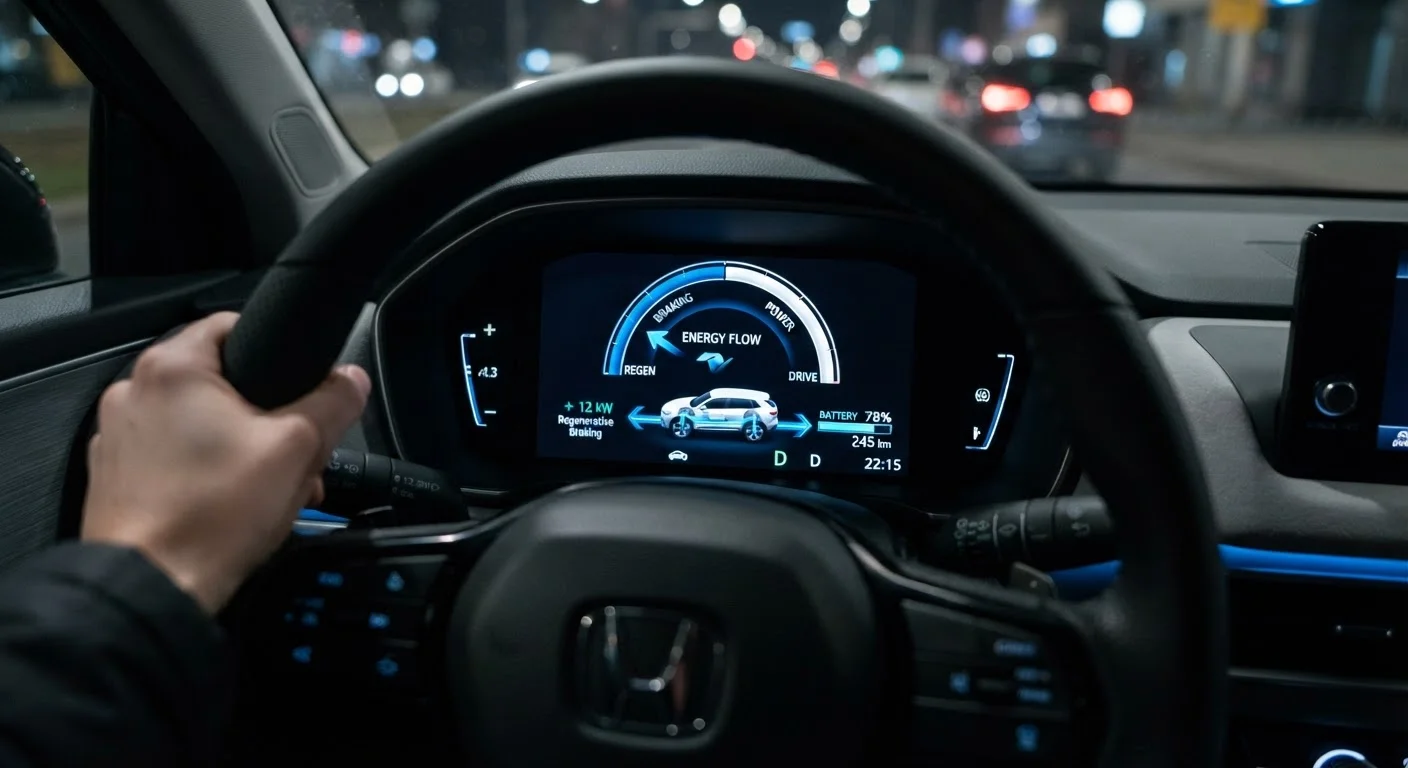
Photo: TheSearchHound.com | One Stop Answer To All Your Questions editorial
Key Takeaways
- Regenerative braking converts slowing-down energy into electricity instead of wasting it as heat.
- The electric motor acts as a generator during deceleration, creating resistance that slows the car.
- Drivers may notice a different brake pedal feel compared to conventional vehicles.
- The system extends EV and hybrid range by continuously topping off the battery during normal driving.
- Friction brakes still engage for hard stops - regenerative braking works alongside them, not instead.
The Problem Conventional Brakes Have Always Had
Every time a traditional vehicle slows down, physics extracts a cost. The car's momentum - its kinetic energy - has to go somewhere, and in a conventional braking system, it converts entirely into heat. That heat radiates off the brake rotors and pads and dissipates into the air, doing nothing useful. Stop-and-go city driving compounds this waste dramatically.
Understanding this loss is the starting point for understanding regenerative braking. It's worth contrasting with how disc and drum brakes work - both rely on friction to shed speed, and both convert motion into heat. Regenerative braking takes a fundamentally different approach.
Up to 70%
Kinetic energy recoverable in city driving
The U.S. Department of Energy has cited estimates suggesting regenerative braking can recover a significant share of energy during urban stop-and-go conditions, though real-world figures vary by vehicle and driving style.
10-15%
Typical range improvement from regenerative braking
Industry engineers commonly attribute a range extension of roughly 10 to 15 percent to regenerative braking systems under mixed driving conditions, though results depend heavily on route type.
How the System Actually Works
In a hybrid or electric vehicle, one or more electric motors power the wheels. When the driver lifts off the accelerator or presses the brake pedal, the control system reverses the motor's role. Instead of consuming electricity to drive the wheels forward, the motor is now driven by the wheels - and in doing so, it generates electricity.
This is the same principle behind a hand-crank flashlight or a bicycle dynamo: mechanical motion in produces electrical energy out. The generated electricity flows back into the vehicle's high-voltage battery pack, partially replenishing the charge that was used during acceleration.
At the same time, the electromagnetic resistance created by the generating motor applies a braking force to the wheels. The driver feels this as natural deceleration. For moderate slowing - the kind that makes up most urban driving - this process alone can handle the job. When stronger braking is needed, the vehicle's conventional hydraulic friction brakes blend in automatically.
Adapt Your Driving Style for Maximum Recovery
What It Feels Like Behind the Wheel
Drivers new to EVs or plug-in hybrids often notice two things immediately: the car slows noticeably when they simply lift their foot off the accelerator, and the brake pedal may feel slightly different from what they're used to.
The first sensation comes from high regenerative braking settings, sometimes called one-pedal driving. In this mode, strong regen deceleration means many drivers can bring the car nearly to a stop without touching the brake pedal at all. Some drivers find this intuitive and efficient; others prefer lower regen settings that feel closer to a conventional vehicle's coast.
The pedal feel difference exists because engineers must blend two separate braking systems - regenerative and friction - behind a single pedal input. Modern vehicles handle this blend well, but it can feel slightly spongy or progressive compared to a traditional all-hydraulic setup. Most drivers adapt within a few days of regular use.
Where Regenerative Braking Makes the Most Difference
The efficiency gains from regenerative braking are most pronounced in stop-and-go city driving. Every red light, every merging slowdown, every crawl through traffic becomes an opportunity to recover energy. On the highway, where deceleration events are rare, the benefit is smaller.
This is one reason why electric and hybrid vehicles often show stronger real-world range in urban environments than highway driving - which flips the expectation many drivers carry over from gasoline-powered cars, where highway cruising is typically more efficient than city driving.
Drivers who understand this dynamic can use it to their advantage. Anticipating stops - coasting toward a red light rather than maintaining speed and braking hard - gives regenerative braking more time to work and reduces wear on friction components simultaneously.
Frequently Asked Questions
The content on this site is provided for informational purposes only and should not be considered a substitute for professional advice. While we strive to provide accurate and up-to-date information, we make no guarantees regarding its completeness or accuracy. Always consult a qualified professional for advice specific to your circumstances before making any decisions.