
Disc Brakes vs. Drum Brakes

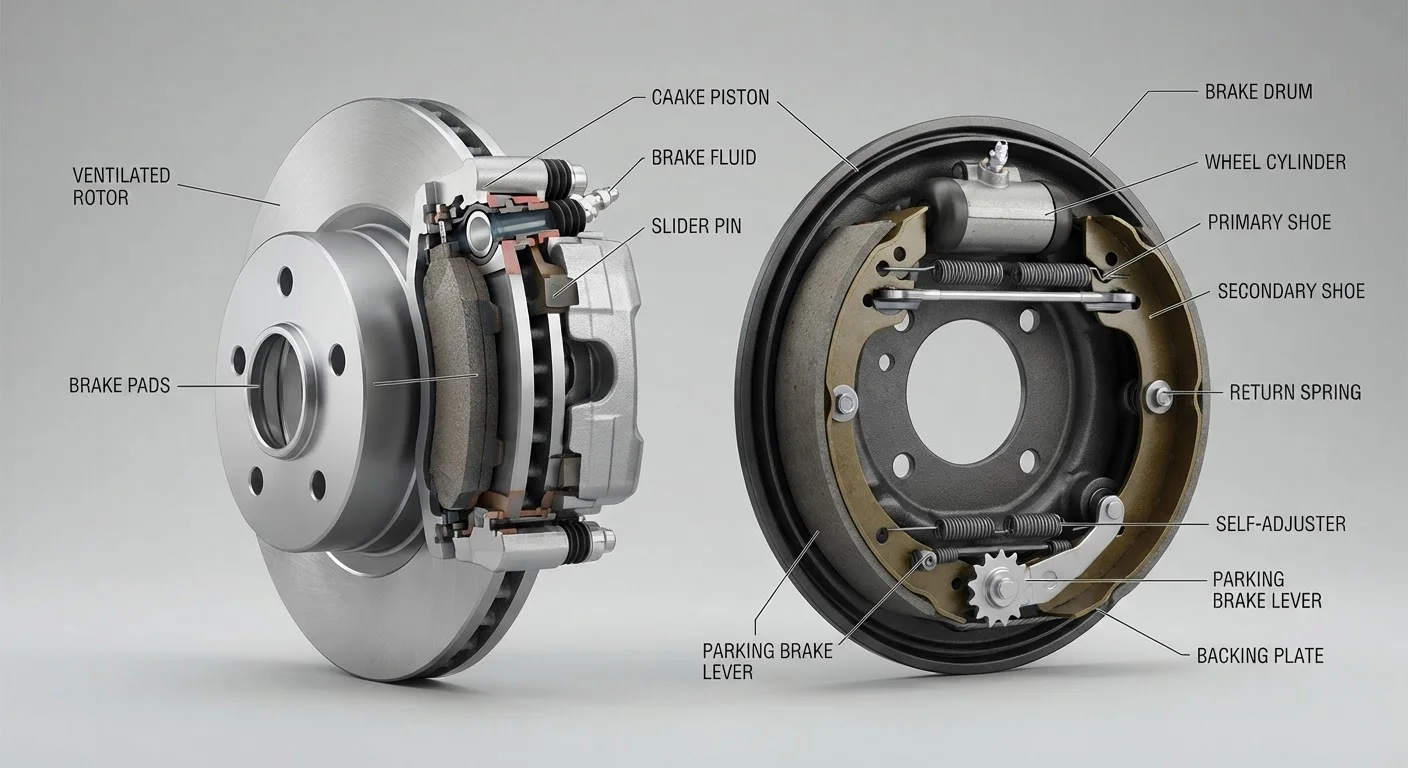
Photo: TheSearchHound.com | One Stop Answer To All Your Questions editorial
Key Takeaways
- Disc brakes use a rotor and caliper; drum brakes use a rotating drum and internal shoes.
- Disc brakes dissipate heat faster, reducing brake fade during heavy or repeated stopping.
- Drum brakes are less expensive to manufacture and integrate a parking brake more easily.
- Most modern vehicles use disc brakes at the front and may use either design at the rear.
- Neither design is universally superior - each suits specific roles and vehicle types.
How Each System Works
Understanding the difference between disc and drum brakes starts with knowing what happens mechanically when you press the brake pedal.
Disc brakes consist of a flat metal rotor attached to the wheel hub. When you brake, hydraulic pressure forces a caliper - a clamp-like device straddling the rotor - to squeeze brake pads against both sides of the spinning disc. Friction converts the vehicle's kinetic energy into heat, slowing the wheel. Because the rotor is exposed to open air, that heat dissipates quickly.
Drum brakes work differently. A hollow metal drum rotates with the wheel. Inside the drum, curved brake shoes are pushed outward against the drum's inner surface by a wheel cylinder when you press the pedal. The resulting friction slows the drum and, with it, the wheel. The enclosed design, however, traps heat inside the assembly.
| Criterion | Disc Brakes | Drum Brakes |
|---|---|---|
| Core components | Rotor, caliper, brake pads | Drum, wheel cylinder, brake shoes |
| Heat dissipation | Excellent - open-air exposure | Limited - enclosed housing traps heat |
| Brake fade resistance | High | Moderate |
| Manufacturing cost | Higher | Lower |
| Ease of inspection | Easier - visible through wheel | Harder - enclosed design |
| Parking brake integration | Requires added hardware | Straightforward - shoes hold drum |
| Typical placement | Front axle; all four on many vehicles | Rear axle on economy and light trucks |
Both systems rely on friction and hydraulic pressure - the core difference lies in geometry, exposure, and how efficiently each sheds the heat that friction generates.
Performance, Heat, and Fade
Heat management is where the two systems diverge most meaningfully for everyday drivers. Brake fade occurs when a brake system overheats to the point where it loses stopping effectiveness - a concern on long mountain descents or during repeated hard stops.
Because disc rotors are open to airflow, they cool rapidly between applications. Many performance rotors are also drilled or slotted to increase surface area and accelerate cooling further. This makes disc brakes noticeably more resistant to fade.
Drum brakes, by contrast, trap heat inside their enclosed housing. Under sustained heavy use, this can lead to reduced braking force. For typical daily driving - moderate stops, city traffic, highway cruising - drums at the rear axle perform adequately. The problem becomes more apparent under conditions that demand repeated, aggressive braking.
60-70%
Braking load handled by front brakes
Weight transfer during deceleration shifts stopping demand heavily to the front axle, which is why front disc brakes are considered essential on virtually all modern vehicles.
~90%
New US passenger cars with front disc brakes
Disc brakes at the front have become the near-universal standard on new passenger vehicles sold in the United States due to their superior fade resistance and shorter stopping distances.
If you're curious how driving style affects brake wear over time, see habits that quietly wear down your vehicle for a broader look at the long-term consequences of everyday driving behavior.
Where Each Type Is Used on Modern Vehicles
On most passenger cars sold in the United States today, you'll find disc brakes on all four wheels or disc brakes at the front and drum brakes at the rear. This split setup reflects a practical engineering trade-off.
Front brakes handle roughly 60-70% of a vehicle's braking load during a stop because weight transfers forward under deceleration. Placing the more capable disc system up front - where stopping demand is highest - makes engineering sense. The rear brakes, handling a lighter share of the load, can use the simpler and cheaper drum design without meaningfully compromising overall stopping performance.
Performance vehicles, larger SUVs, and trucks often run four-wheel disc setups. Economy cars and some light commercial vehicles may retain rear drums to keep manufacturing costs down. Drum brakes also integrate more naturally with a mechanical parking brake, since the shoes can be held against the drum's inner surface without complex additional hardware.
For vehicles with regenerative braking - hybrids and EVs - discs at the rear are increasingly common because the friction brakes are used less frequently, and drum brakes can corrode or seize from infrequent use. Learn more about how that technology works in our overview of what regenerative braking does in hybrid and electric vehicles.
Maintenance and Warning Signs
Both brake types wear over time and require periodic inspection. Disc brake pads are generally easier to inspect visually - a mechanic or even a careful owner can often check pad thickness through the wheel spokes. Drum brake shoes are enclosed, making visual inspection harder without removing the drum.
Disc brake rotors can warp from excessive heat, causing a pulsing sensation through the brake pedal. Pads wear down and eventually contact metal to metal, producing a grinding noise. Drums can score or crack under extreme heat, and the self-adjusting mechanisms inside can seize if the brakes are rarely used.
Common warning signs span both types: squealing, grinding, vibrating, or the vehicle pulling to one side during braking all deserve prompt attention from a qualified mechanic. Our guide on when your brakes are trying to get your attention covers what these symptoms mean and which require urgent action.
Regardless of brake type, having your braking system inspected at regular service intervals - or any time you notice a change in feel or sound - is the most reliable way to stay safe on the road.
The content on this site is provided for informational purposes only and should not be considered a substitute for professional advice. While we strive to provide accurate and up-to-date information, we make no guarantees regarding its completeness or accuracy. Always consult a qualified professional for advice specific to your circumstances before making any decisions.