
Why Wheel Alignment and Tire Balancing Are Two Different Services

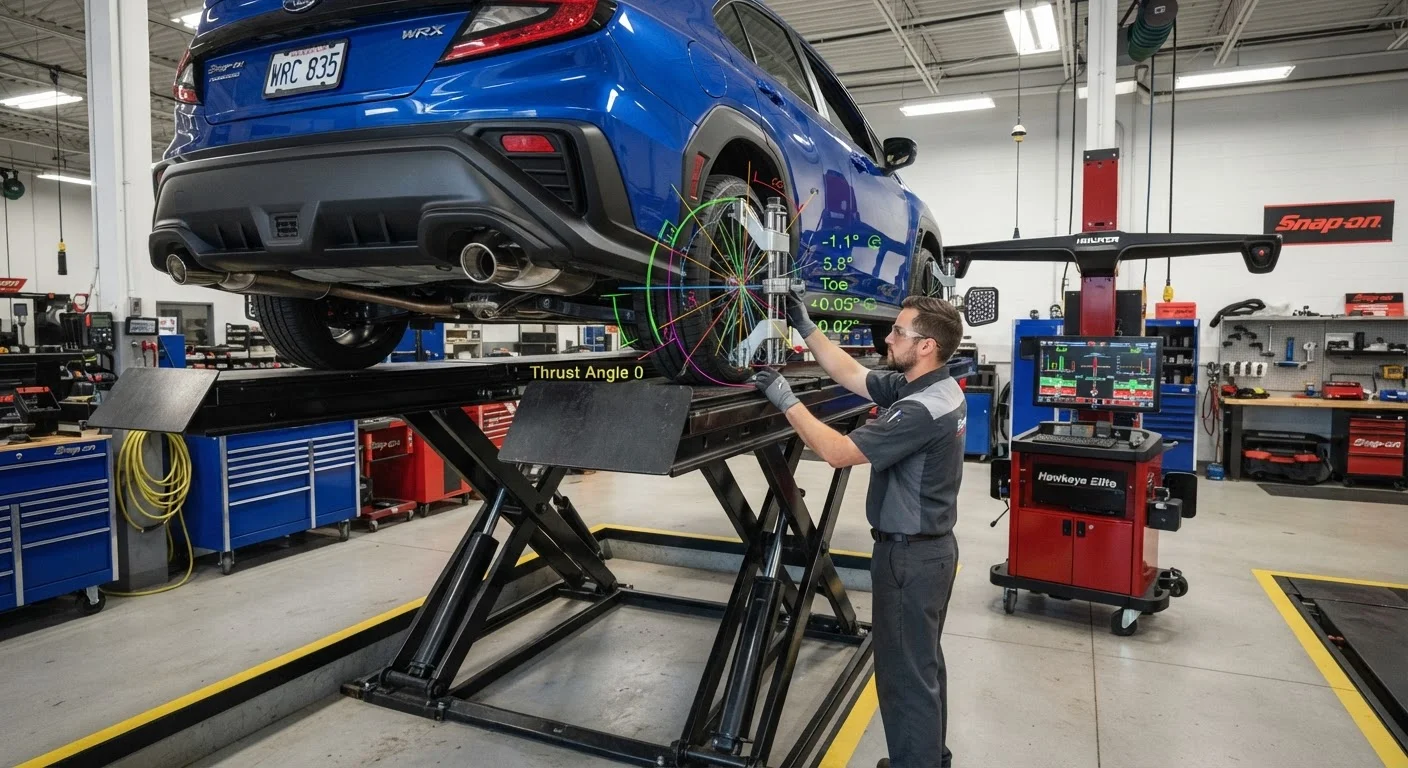
Photo: TheSearchHound.com | One Stop Answer To All Your Questions editorial
Key Takeaways
- Wheel alignment adjusts the angles at which your tires contact the road; balancing corrects uneven weight distribution around the tire and wheel.
- Misalignment causes uneven, accelerated tire wear and pulling; imbalance causes vibration, usually felt most at 55-70 mph.
- Both services are distinct - fixing one does not fix the other, and each has its own symptoms and service intervals.
- New tires, hitting a large pothole, or noticing a shimmy are all common triggers for one or both services.
- Always consult a qualified mechanic when symptoms appear; guessing which service you need can cost extra money and time.
What Wheel Alignment Actually Does
Wheel alignment is about angles. Specifically, it refers to adjusting the orientation of your tires relative to each other and to the road surface. Technicians measure three primary angles: camber (the inward or outward tilt of the tire when viewed from the front), toe (whether the fronts of the tires point inward or outward like pigeon toes), and caster (the forward or backward tilt of the steering axis).
When any of these angles drift outside the manufacturer's specified range - usually from hitting a pothole, running over a curb, or simply years of normal wear - the vehicle no longer handles as designed. You might notice the car pulling to one side, the steering wheel sitting off-center on a straight road, or tires wearing unevenly in a way that looks like a bald strip on the inner or outer edge.
Alignment work involves a technician placing sensors on each wheel, reading the current angles on a computerized system, and then adjusting suspension and steering components until all angles return to spec. It does not involve adding anything to the tire itself.
| Criterion | Wheel Alignment | Tire Balancing |
|---|---|---|
| What it fixes | Incorrect wheel angles | Uneven weight distribution |
| Primary symptom | Car pulls to one side | Vibration at highway speeds |
| Visible tire damage | Inner or outer edge wear | Cupping or scalloping pattern |
| Service method | Adjusting suspension angles | Adding counterweights to rim |
| Common trigger | Pothole, curb impact, worn parts | New tires, weight loss from rim |
| Typical service interval | Every 1-2 years or after impact | With new tires or every 5,000-6,000 miles |
| Does fixing one fix the other? | No | No |
What Tire Balancing Actually Does
Tire balancing addresses a completely different physics problem: uneven weight distribution around the tire and wheel assembly. Even a brand-new, perfectly round tire has minor variations in mass throughout its structure. When mounted on a wheel, these variations can create imbalance that causes the assembly to rotate unevenly at speed.
The result is vibration - typically felt as a shimmy in the steering wheel, the seat, or the floor, and most pronounced at speeds between roughly 55 and 70 mph. The vibration tends to smooth out at lower speeds and can sometimes reappear or worsen at higher ones.
To balance a tire, a technician mounts the wheel on a balancing machine that spins it and measures where the heavy spots are. Small weights - usually adhesive or clip-on - are then attached to the wheel rim at precise locations to counteract those heavy spots. The goal is a rotation that is smooth at all speeds.
For a broader look at how balancing compares to rotation and alignment together, see our guide on tire rotation, balancing, and alignment.
Weights Can Fall Off Over Time
How to Tell Which Service You Need
Because the two services solve different problems, their symptoms are distinct enough to give you a reasonable starting point before visiting a shop.
~$50-$100
Typical cost for a four-wheel alignment
Costs vary by region and vehicle type; always get a shop estimate before authorizing work.
~$10-$15 per tire
Typical cost to balance one tire
Many shops include balancing in the price of new tire installation as a standard package.
- Pulling or drifting on a straight road → likely an alignment issue
- Uneven tire wear (feathering, inner or outer edge wear) → likely an alignment issue
- Steering wheel off-center on a straight road → likely an alignment issue
- Vibration or shimmy at highway speeds → likely a balancing issue
- Vibration that changes with speed → likely a balancing issue
Note that symptoms can overlap, and one problem can accelerate the other. Persistent misalignment causes uneven wear; worn tires can make vibration worse. A qualified technician can diagnose both in a single visit, and many shops check for both when performing either service.
This article is for general informational purposes only. Always consult a qualified mechanic for diagnosis and repair specific to your vehicle.
The content on this site is provided for informational purposes only and should not be considered a substitute for professional advice. While we strive to provide accurate and up-to-date information, we make no guarantees regarding its completeness or accuracy. Always consult a qualified professional for advice specific to your circumstances before making any decisions.