
Tire Rotation, Balancing, and Alignment: Three Jobs People Often Confuse

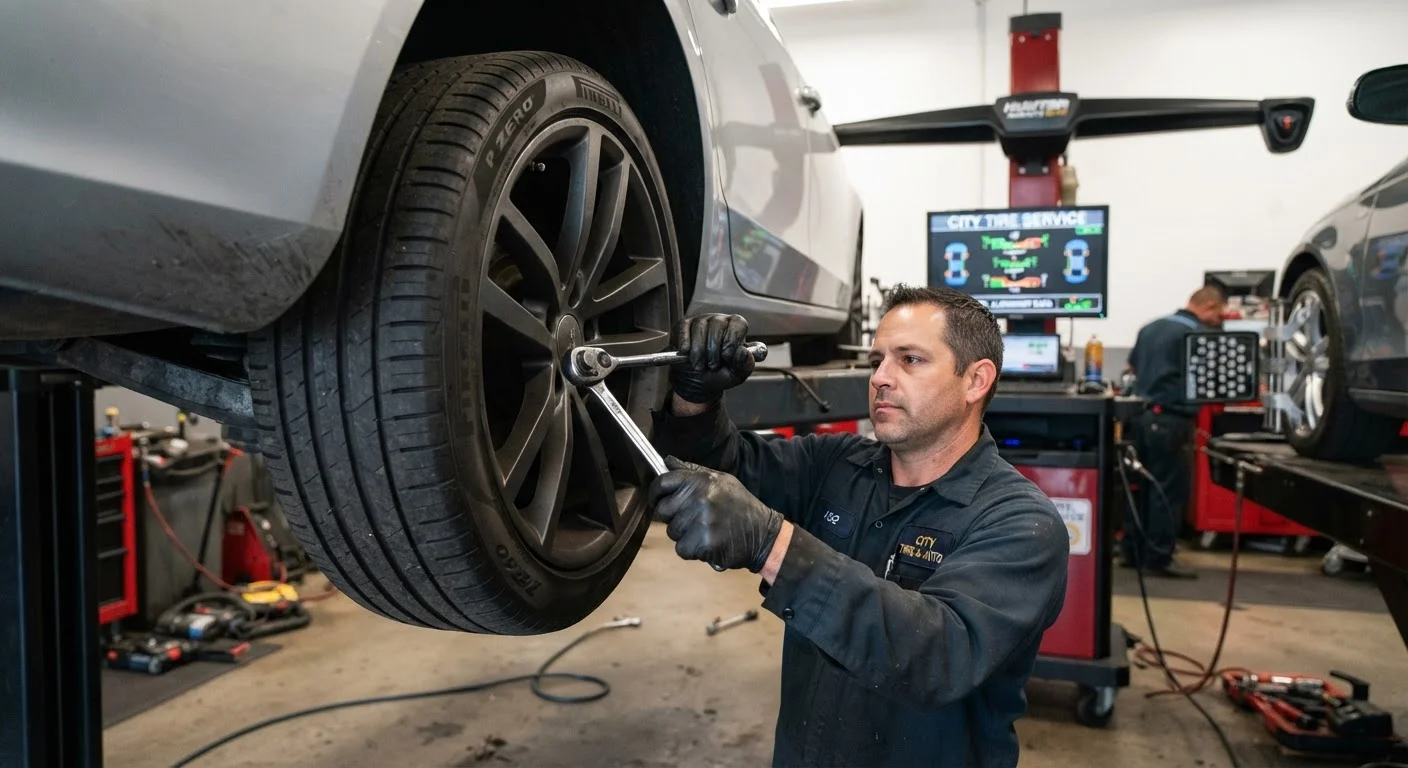
Photo: TheSearchHound.com | One Stop Answer To All Your Questions editorial
Key Takeaways
- Tire rotation moves tires between positions to equalize tread wear across all four.
- Balancing corrects uneven weight distribution in a wheel-and-tire assembly to eliminate vibration.
- Alignment adjusts the angles of your wheels relative to each other and the road surface.
- Confusing these services can leave real problems unaddressed and shorten tire life.
- Each service has its own recommended interval and distinct set of symptoms when overdue.
Why the Confusion Exists
At a shop counter, all three services sound like they involve your tires - because they do. But that's roughly where the similarity ends. Rotation, balancing, and alignment each target a fundamentally different problem, require different equipment, and produce different results. Mixing them up in conversation isn't just a terminology error; it can mean the actual issue with your vehicle goes undiagnosed and unfixed.
Understanding what each service actually does puts you in a much stronger position when talking to a technician, reading a service estimate, or deciding which appointment to schedule first. For a deeper look at the data stamped on your tires, see Tire Pressure, Load Rating, and Sidewall Numbers Decoded.
Tire Rotation: Moving Tires to Even Out Wear
Rotation is the simplest of the three concepts. It means physically moving each tire to a different position on the vehicle - for example, front-left to rear-left, or crossing diagonally - according to a predetermined pattern. The goal is to equalize tread wear across all four tires.
Front tires typically wear faster than rears because they handle steering forces in addition to braking. On front-wheel-drive vehicles, the fronts also bear the load of acceleration. Without regular rotation, the fronts can wear down significantly faster than the rears, meaning you'd replace two tires when all four could have reached end-of-life together.
Most manufacturers and technicians recommend rotation every 5,000 to 7,500 miles, though your owner's manual is the authoritative source for your specific vehicle. Rotation doesn't fix vibration or pulling - it's purely a preventive wear-management strategy.
Bundle Services Strategically
Wheel Balancing: Correcting Weight Distribution
A tire and wheel assembly is rarely perfectly uniform in weight. Small variations in rubber density, the valve stem, or minor manufacturing differences can create a heavy spot. When that assembly spins at highway speed, the heavy spot causes a repeating wobble - which you feel as a vibration in the steering wheel, seat, or floorboard.
Balancing corrects this by mounting the wheel on a spin balancer, identifying the heavy spot, and attaching small counterweights to the rim at precise locations. The result is a smoother ride with less stress on suspension components.
Common signs that balancing is overdue include vibration that appears or worsens between 50-70 mph and disappears at lower speeds, or a steering wheel that trembles on smooth pavement. Balancing is also recommended any time a tire is dismounted and remounted - such as after a puncture repair. For a direct comparison of balancing versus alignment, Why Wheel Alignment and Tire Balancing Are Two Different Services breaks it down clearly.
| Tire Rotation | Wheel Balancing | Wheel Alignment | |
|---|---|---|---|
| What it fixes | Uneven tread wear across positions | Vibration from weight imbalance | Incorrect wheel angles causing pull or wear |
| Equipment used | Lift and hand tools | Spin balancer and wheel weights | Alignment rack with angle sensors |
| Typical symptom when needed | Faster wear on front or rear tires | Vibration at highway speeds | Vehicle pulls to one side; feathered tread |
| Recommended interval | Every 5,000-7,500 miles | Every tire mount or when vibration appears | Annually or after major impact |
| Can substitute for the others? | No | No | No |
Wheel Alignment: Setting the Angles
Alignment has nothing to do with moving tires between positions or adding weights. It's the adjustment of the angles at which your tires meet the road, relative to each other and to the vehicle's centerline. The three main angles technicians measure are camber (inward or outward tilt of the tire when viewed head-on), toe (whether tires point slightly inward or outward), and caster (the steering axis angle viewed from the side).
When these angles drift out of specification - which can happen gradually over time or suddenly after hitting a significant pothole or curb - the tires scrub against the pavement at a slight angle rather than rolling straight. This produces characteristic diagonal or feathered wear patterns on the tread and often causes the vehicle to pull to one side without driver input.
Alignment is checked on a dedicated rack using sensors attached to each wheel. Corrections are made by adjusting suspension components - no weights, no tire swapping. Routine checks are generally recommended once a year or whenever you notice pulling, drifting, or rapid uneven tread wear. Vehicle Maintenance Items Drivers Frequently Overlook covers other services that similarly fly under the radar.
Putting It All Together
None of these three services is interchangeable, and each addresses something the others cannot. If your car vibrates at highway speed, rotation won't solve it - balancing will. If it pulls left, balancing won't help - alignment will. And if your front tires simply wear faster than your rears, rotation is the targeted fix.
The good news is that these services are often affordable when kept current, and their combined effect - even tread, smooth rotation, and proper wheel angles - directly supports safe, efficient driving. Letting any one of them lapse doesn't just affect comfort; it accelerates tire wear and can put more stress on steering and suspension parts. For context on how tire condition ties into overall safety, Why Tire Pressure Matters More Than Most Drivers Realize is a useful companion read.
The content on this site is provided for informational purposes only and should not be considered a substitute for professional advice. While we strive to provide accurate and up-to-date information, we make no guarantees regarding its completeness or accuracy. Always consult a qualified professional for advice specific to your circumstances before making any decisions.