
Budgeting by Paycheck vs. Budgeting by Month: Two Timelines, Different Results

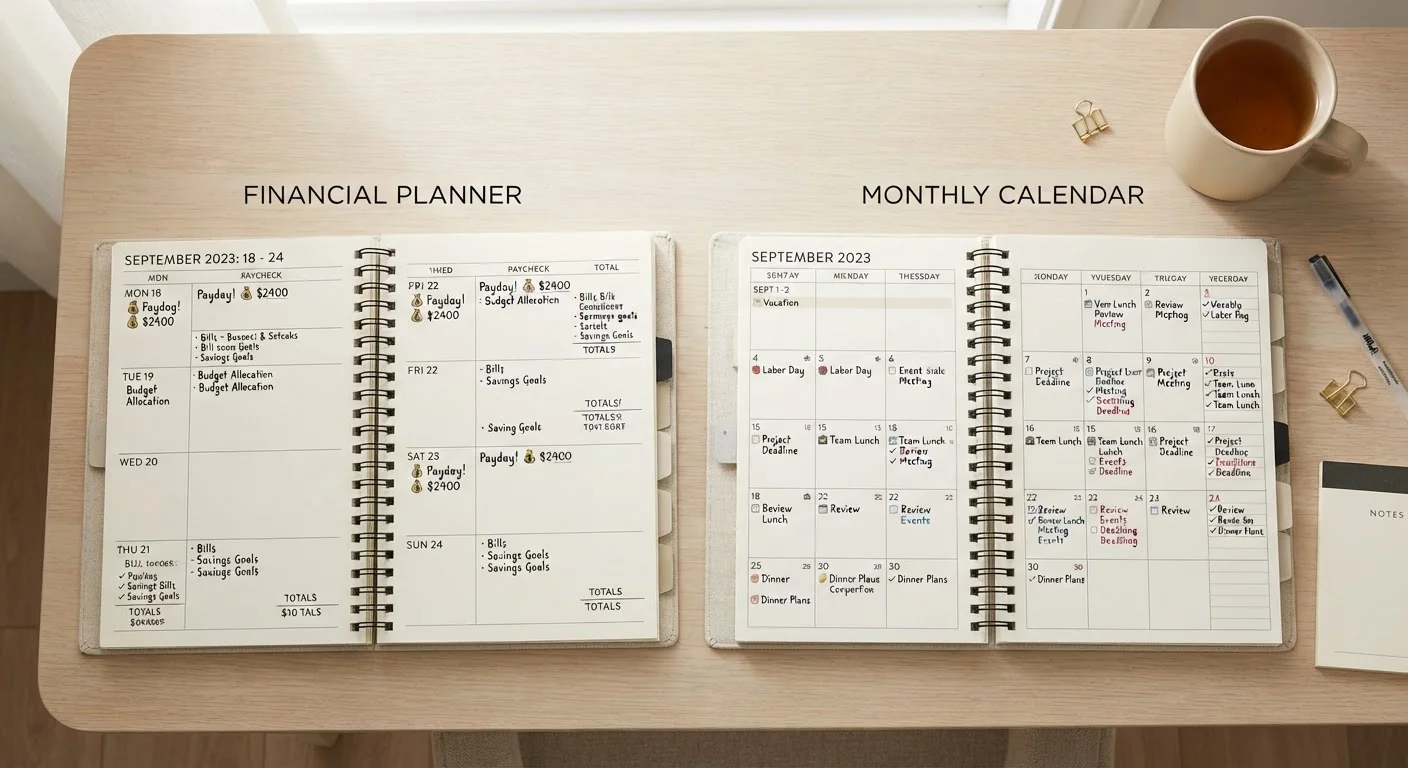
Photo: TheSearchHound.com | One Stop Answer To All Your Questions editorial
Key Takeaways
- Paycheck-based budgeting aligns spending decisions with actual cash availability, reducing overdraft risk.
- Monthly budgeting provides a broader view of income and expenses, making it easier to track recurring bills.
- Your pay frequency-weekly, biweekly, or semimonthly-often determines which approach causes less friction.
- Either method works best when paired with clearly defined financial goals before you begin.
- Many people combine both timelines: a monthly overview with paycheck-level spending checkpoints.
Why the Timeline You Choose Actually Matters
A budget is only as useful as its fit with real life. One of the most overlooked design decisions is the time horizon: should you plan around each paycheck you receive, or map everything out across a full calendar month? The choice affects how you allocate money, when you make spending decisions, and how quickly you catch problems before they turn into overdrafts or missed bills.
Before choosing a structure, it helps to get clear on what you're trying to accomplish. As our editorial team has noted, defining your financial goals first makes the mechanics you layer on top far more effective. Without that foundation, either timeline becomes just number-tracking.
Understanding how fixed and variable expenses behave differently is also essential groundwork-because those two expense types interact with paycheck and monthly timelines in distinct ways.
How Paycheck-Based Budgeting Works
Paycheck budgeting means you plan each spending period from the moment money lands in your account to the moment the next deposit arrives. If you're paid biweekly, you're working in roughly two-week cycles. Every paycheck gets its own mini-budget: specific bills, savings transfers, and discretionary spending are assigned to that specific pot of money.
Strengths
- Matches actual cash availability. You only spend what you have right now, reducing the gap between your plan and your bank balance.
- Catches shortfalls early. If you overspend in week one of a two-week cycle, you see it immediately rather than at month-end.
- Useful for tight cash flow. People living paycheck to paycheck often find this format less abstract and easier to maintain.
Limitations
- Some bills don't align cleanly. Monthly obligations like rent or utilities may fall mid-cycle or straddle two paychecks, requiring manual adjustment each period.
- Harder to track long-range goals. Seeing the full month's savings progress or debt paydown requires manually stitching cycles together.
- More frequent planning effort. If you're paid weekly, that's 52 mini-budgets per year-a real administrative load.
Bridging the Biweekly Gap
How Monthly Budgeting Works
Monthly budgeting treats the calendar month as a single financial unit. All expected income-regardless of how many paychecks arrive-and all anticipated expenses are mapped together. You set category limits at the start of the month and track spending against them over 30 or 31 days.
Strengths
- Mirrors how most bills are billed. Rent, utilities, insurance, and subscriptions all operate on monthly cycles, so the timeline aligns naturally.
- Cleaner big-picture view. Monthly totals make it easier to compare spending patterns over time and spot trends.
- Better for goal tracking. Monthly savings targets, debt paydown amounts, and investment contributions are straightforward to calculate and review.
Limitations
- Can mask mid-month cash gaps. A monthly plan might show you're on track overall while your account runs low between the 1st and 15th.
- Requires income smoothing for irregular earners. If your paychecks vary in size or timing, a fixed monthly budget can feel disconnected from reality. For those situations, budgeting on an irregular income calls for a different approach entirely.
| Paycheck Budgeting | Monthly Budgeting | |
|---|---|---|
| Planning horizon | Each pay cycle (weekly to biweekly) | Full calendar month |
| Best pay frequency match | Weekly or biweekly earners | Semimonthly or monthly earners |
| Bill alignment | Requires manual adjustment for monthly bills | Naturally mirrors most billing cycles |
| Cash-flow visibility | High - reflects real-time balance | Lower - can mask mid-month gaps |
| Goal tracking ease | Requires stitching cycles together | Straightforward monthly totals |
| Planning effort | Higher - more frequent mini-budgets | Lower - plan once per month |
| Overdraft risk management | Strong - spend only what's arrived | Moderate - depends on cash-flow discipline |
How Pay Frequency Influences the Decision
Your employer's payroll schedule plays a large role in which timeline makes more sense.
- Weekly pay: Paycheck budgeting is natural but high-effort. A monthly overview with weekly check-ins may reduce friction.
- Biweekly pay (26 checks/year): Two months each year include a third paycheck-monthly budgets built around two checks will need adjustment in those months. Paycheck budgeting handles this automatically.
- Semimonthly pay (24 checks/year, e.g., 1st and 15th): Clean split that pairs well with either approach; monthly budgeting is especially straightforward here.
- Monthly pay: Monthly budgeting is essentially built in-there's only one paycheck to plan around.
Once you've settled on a timeline, you'll also want to choose a budgeting framework to work within. Our comparison of zero-based budgeting vs. the 50/30/20 rule walks through two of the most widely used approaches and who each one suits.
Combining Both Timelines
Many financially organized households don't choose exclusively between the two-they use a layered approach. The monthly budget functions as the strategic overview: total income, total spending categories, savings goals, and bill schedules. Paycheck-level checkpoints then serve as tactical check-ins, confirming that enough cash is on hand for the obligations due before the next deposit.
In practice, this might look like setting a monthly grocery limit of $400, then confirming that each paycheck's discretionary allocation leaves room to hit that target without overspending in week one. If you're ready to build out the structure, the monthly budget setup checklist covers everything to gather and confirm before finalizing your plan.
There are also common assumptions worth setting aside before you start-like the idea that budgeting is only for people in financial trouble. Our piece on budgeting myths that keep people from starting addresses several of these directly.
This article is for general informational and educational purposes only and does not constitute personalized financial advice. Readers should consider consulting a qualified financial professional for guidance specific to their own circumstances.
The content on this site is provided for informational purposes only and should not be considered a substitute for professional advice. While we strive to provide accurate and up-to-date information, we make no guarantees regarding its completeness or accuracy. Always consult a qualified professional for advice specific to your circumstances before making any decisions.