
Therapy, Counseling, and Psychiatry: Understanding the Differences

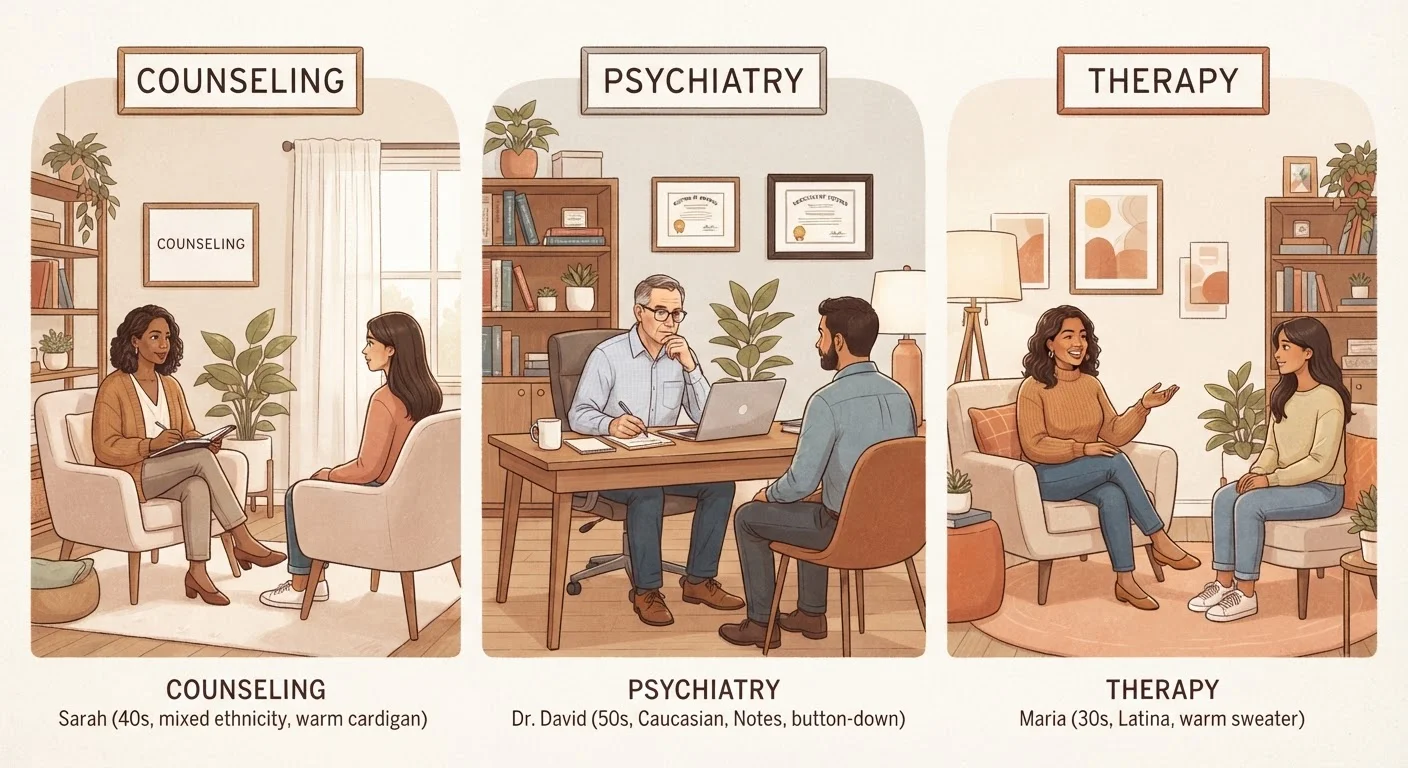
Photo: TheSearchHound.com | One Stop Answer To All Your Questions editorial
Key Takeaways
- Therapists, counselors, and psychiatrists are distinct professionals with different training, roles, and scopes of practice.
- Psychiatrists are medical doctors who can prescribe medication; therapists and counselors generally cannot.
- Counselors typically focus on specific life challenges, while therapists address deeper or longer-term mental health concerns.
- Many people benefit from a combination of psychiatric care and talk therapy working together.
- Choosing the right professional starts with understanding what kind of support you are looking for.
Why the Distinctions Matter
When someone decides to seek mental health support, one of the first - and most confusing - questions is: who exactly should I see? The terms "therapist," "counselor," and "psychiatrist" are often used interchangeably in everyday conversation, but they refer to meaningfully different professionals with different training, responsibilities, and scopes of practice.
Understanding these differences isn't just a matter of semantics. Seeing the right type of professional for your particular needs can affect how quickly you feel supported and how effectively your care is coordinated. For a broader foundation, explore what mental health really means beyond clinical labels.
If any of the terminology here feels unfamiliar, our mental health glossary offers plain-language definitions for common terms you may encounter.
Therapists and Psychotherapists: In-Depth Psychological Work
The term therapist - often used interchangeably with psychotherapist - generally refers to a licensed mental health professional trained to provide structured, evidence-based talk therapy. This category includes licensed clinical social workers (LCSWs), licensed professional counselors (LPCs), licensed marriage and family therapists (LMFTs), and psychologists (PhD or PsyD), among others.
Therapists are trained to assess, diagnose, and treat a wide range of mental health conditions through therapeutic modalities. These may include cognitive behavioral therapy (CBT), dialectical behavior therapy (DBT), trauma-focused approaches, and more. If you're curious about one of the most widely studied approaches, see our overview of how cognitive behavioral therapy works.
In most U.S. states, therapists - with the exception of certain specially licensed psychologists - cannot prescribe medication. Their work is centered on behavioral, emotional, and psychological change through the therapeutic relationship and structured techniques.
How to Choose Where to Start
Counselors: Guidance Through Specific Challenges
Counselors often overlap with therapists in training and licensure, but the term traditionally implies a focus on more specific, situational support - such as grief, career transitions, substance use recovery, or relationship difficulties. School counselors, substance abuse counselors, and career counselors fall under this umbrella.
Licensed counselors (such as LPCs or licensed mental health counselors, LMHCs) hold graduate-level degrees and are trained to support individuals through life challenges using structured techniques. While some counselors are also trained in evidence-based therapies for clinical conditions, others focus primarily on psychoeducation, coping skill development, and short-term problem-solving.
The distinction between "counselor" and "therapist" is often blurry in practice, since licensing requirements vary by state and professionals sometimes use these titles interchangeably. When evaluating a potential provider, ask about their specific credentials, training, and areas of specialty rather than relying solely on their job title.
Psychiatrists: Medical Expertise and Medication Management
A psychiatrist is a fully licensed medical doctor (MD or DO) who has completed a residency in psychiatry after medical school. This medical background is the key differentiator: psychiatrists are qualified to diagnose mental health conditions and prescribe and manage psychiatric medications.
Psychiatric evaluation is often recommended when a condition may have a biological component that could respond to medication - such as major depressive disorder, bipolar disorder, schizophrenia, or attention-deficit/hyperactivity disorder (ADHD). Some psychiatrists also provide talk therapy, though many focus primarily on medication management and refer patients to therapists for ongoing counseling.
It's worth noting that in some states, specially trained psychiatric-mental health nurse practitioners (PMHNPs) can also prescribe psychiatric medications, expanding access in areas where psychiatrist availability is limited.
| Therapist / Psychotherapist | Counselor | Psychiatrist | |
|---|---|---|---|
| Core degree | Master's or doctoral (MSW, PhD, PsyD, LMFT) | Master's level (LPC, LMHC, MEd) | Medical degree (MD or DO) + residency |
| Can prescribe medication | No (in most U.S. states) | No | Yes |
| Can diagnose mental health conditions | Yes | Often yes, depending on license | Yes |
| Primary approach | Evidence-based talk therapy | Guidance, coping skills, psychoeducation | Medical evaluation and medication management |
| Typical session focus | Emotional, behavioral, psychological patterns | Specific life challenges or transitions | Symptom review, medication efficacy, side effects |
| Common conditions addressed | Anxiety, depression, trauma, personality disorders | Grief, substance use, relationship issues, stress | Bipolar disorder, schizophrenia, ADHD, major depression |
Conditions like anxiety and depression are among the most common reasons people seek psychiatric or therapeutic care - and understanding which professional to start with can make the process less overwhelming.
How These Professionals Often Work Together
In practice, mental health care frequently involves collaboration. A psychiatrist might manage a patient's medication while a therapist provides weekly talk therapy sessions. This integrated approach is common for conditions that respond well to a combination of pharmacological and behavioral treatment.
Primary care physicians also play a role - many people first discuss mental health concerns with their family doctor, who may then provide referrals or, in some cases, prescribe common psychiatric medications themselves before a psychiatrist is involved.
The U.S. mental health system has significant access gaps; according to data from the National Alliance on Mental Illness (NAMI), a majority of adults with mental illness do not receive treatment in a given year. Understanding which professional to contact first can help reduce delays. Key statistics on mental health in America provide useful context for how widespread these challenges are.
This article is for general informational and educational purposes only and is not a substitute for professional medical or mental health advice. Always consult a qualified healthcare provider regarding your specific circumstances or symptoms.
The content on this site is provided for informational purposes only and should not be considered a substitute for professional advice. While we strive to provide accurate and up-to-date information, we make no guarantees regarding its completeness or accuracy. Always consult a qualified professional for advice specific to your circumstances before making any decisions.