
Anxiety and Depression Are Not the Same Thing

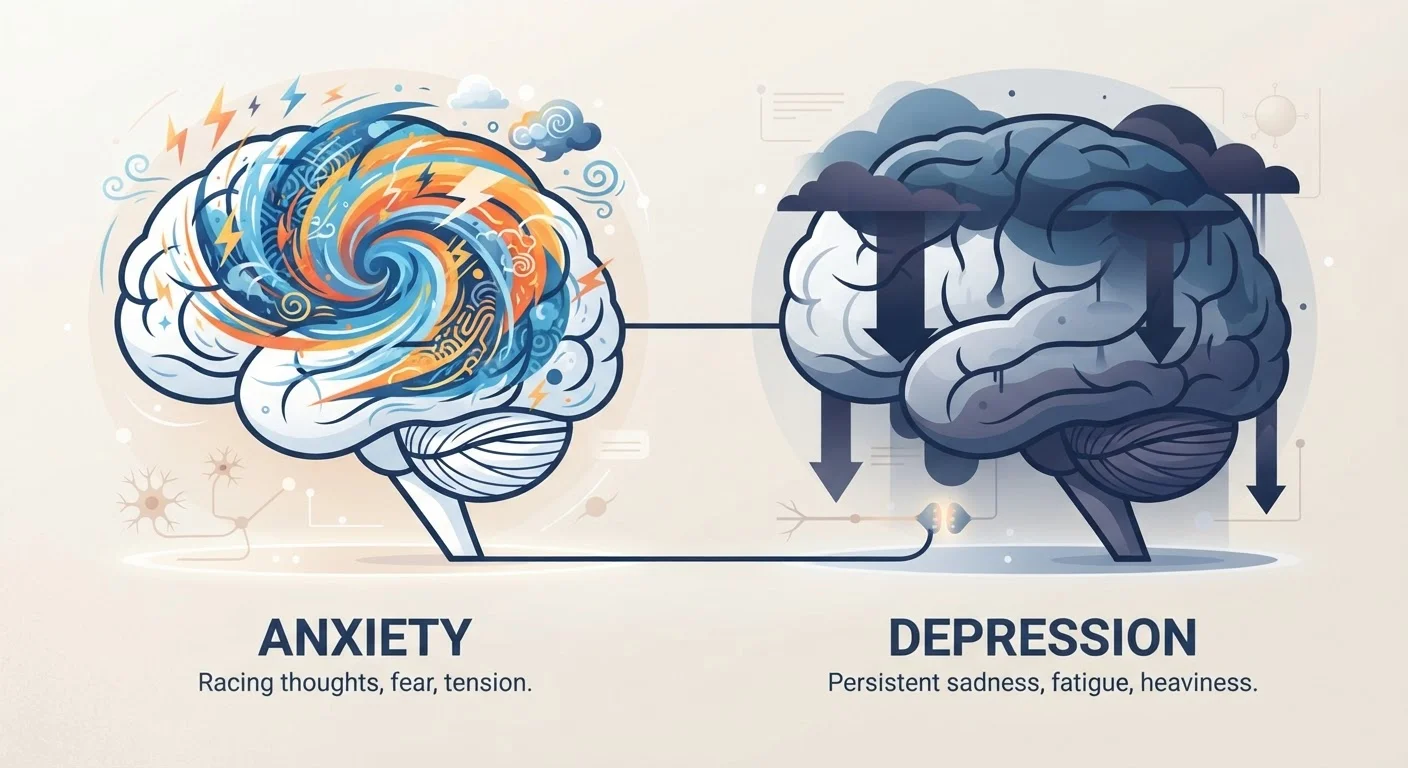
Photo: TheSearchHound.com | One Stop Answer To All Your Questions editorial
Key Takeaways
- Anxiety and depression are distinct diagnoses with different core symptoms and emotional profiles.
- Anxiety is primarily future-focused; depression tends to center on persistent low mood and loss of interest.
- Both conditions can occur together - a pattern clinicians call comorbidity - making accurate diagnosis important.
- Effective, evidence-based treatments exist for both conditions, often including therapy and lifestyle support.
- Only a qualified mental health professional can accurately diagnose either condition.
Two Conditions, One Common Misconception
Anxiety and depression are two of the most frequently discussed mental health conditions in America - and two of the most commonly conflated. People use the terms interchangeably in everyday conversation, but clinically and experientially, they describe different things. Understanding that distinction matters, both for reducing stigma and for getting the right kind of support.
This isn't about splitting hairs. When these conditions are misunderstood or mislabeled, people may not recognize what they're experiencing - or may feel their struggles don't quite fit the story they've been told. For a broader foundation, it helps to start with what mental health actually means beyond clinical shorthand.
| Criterion | Anxiety Disorders | Depression |
|---|---|---|
| Core emotional experience | Excessive fear, worry, dread | Persistent sadness, emptiness, numbness |
| Time orientation | Future-focused ("what if") | Present-focused (heavy, stuck feeling) |
| Energy and motivation | Often high; fear overrides action | Often very low; motivation depleted |
| Physical symptoms | Tension, racing heart, restlessness | Fatigue, appetite/sleep changes, heaviness |
| Relationship with enjoyment | Enjoyment possible but blocked by fear | Loss of interest or pleasure (anhedonia) |
| Common thought patterns | Catastrophizing, hypervigilance | Hopelessness, worthlessness, self-blame |
| Can co-occur with the other? | Yes - comorbidity is common | Yes - comorbidity is common |
What Defines Anxiety
Anxiety disorders are characterized by excessive, persistent fear or worry that is difficult to control and disproportionate to the situation at hand. The emotional experience is largely future-oriented - the mind fixates on what might go wrong, catastrophizes potential outcomes, or stays on high alert even when there is no immediate threat.
Physically, anxiety often shows up as muscle tension, restlessness, a racing heart, or difficulty sleeping. Cognitively, it can mean intrusive "what if" thoughts or difficulty concentrating because the mind is occupied with perceived threats. Anxiety can be generalized (spread across many areas of life) or tied to specific situations, such as social settings or particular fears.
Importantly, people with anxiety often want to engage with life - they may be driven and goal-oriented - but fear holds them back. That activation is a key differentiator from depression.
Anxiety Is Not Just 'Stress'
What Defines Depression
Major Depressive Disorder (commonly called depression) is defined by a persistent low or empty mood lasting most of the day, nearly every day, for at least two weeks - along with other symptoms such as loss of interest in activities once enjoyed (called anhedonia), fatigue, changes in sleep or appetite, difficulty concentrating, and feelings of worthlessness or hopelessness.
Unlike anxiety's forward-facing dread, depression is often experienced as a weight pressing down on the present. People describe it as feeling numb, disconnected, or hollow rather than afraid. The urge to withdraw and the absence of motivation are often more pronounced than any specific fear about the future.
Depression is also not simply sadness. Sadness is a normal, temporary emotional response to difficult events. Depression is a clinical condition with neurological and psychological dimensions that typically requires professional support to address effectively. You can explore more terminology in the mental health glossary.
When They Overlap - and Why That Matters
Here's where the picture gets more complex: anxiety and depression frequently co-occur. Research consistently shows that a significant proportion of people diagnosed with one condition also meet criteria for the other - a pattern known as comorbidity. This overlap can make self-identification harder and underscores why a professional evaluation is always preferable to self-diagnosis.
When both are present, they don't simply add together - they interact. Anxiety's sleeplessness and exhaustion can deepen depression's fatigue; depression's withdrawal can intensify anxiety's isolation. Sleep quality is often a casualty of both, as explored in the connection between sleep and mental health.
Treatment approaches for comorbid anxiety and depression exist and are well-established. Cognitive Behavioral Therapy (CBT), for instance, has strong evidence for both conditions. Medication options also differ between the two, which is one reason accurate diagnosis by a qualified clinician - whether a therapist, psychologist, or psychiatrist - is genuinely important. If you're unsure what kind of professional to see, understanding the differences between therapy, counseling, and psychiatry is a helpful place to start.
This article is for informational and educational purposes only and does not constitute medical advice. If you are experiencing symptoms of anxiety, depression, or any other mental health concern, please consult a qualified healthcare or mental health professional.
The content on this site is provided for informational purposes only and should not be considered a substitute for professional advice. While we strive to provide accurate and up-to-date information, we make no guarantees regarding its completeness or accuracy. Always consult a qualified professional for advice specific to your circumstances before making any decisions.