
Whole Grains vs. Refined Grains: What the Difference Means for Your Health

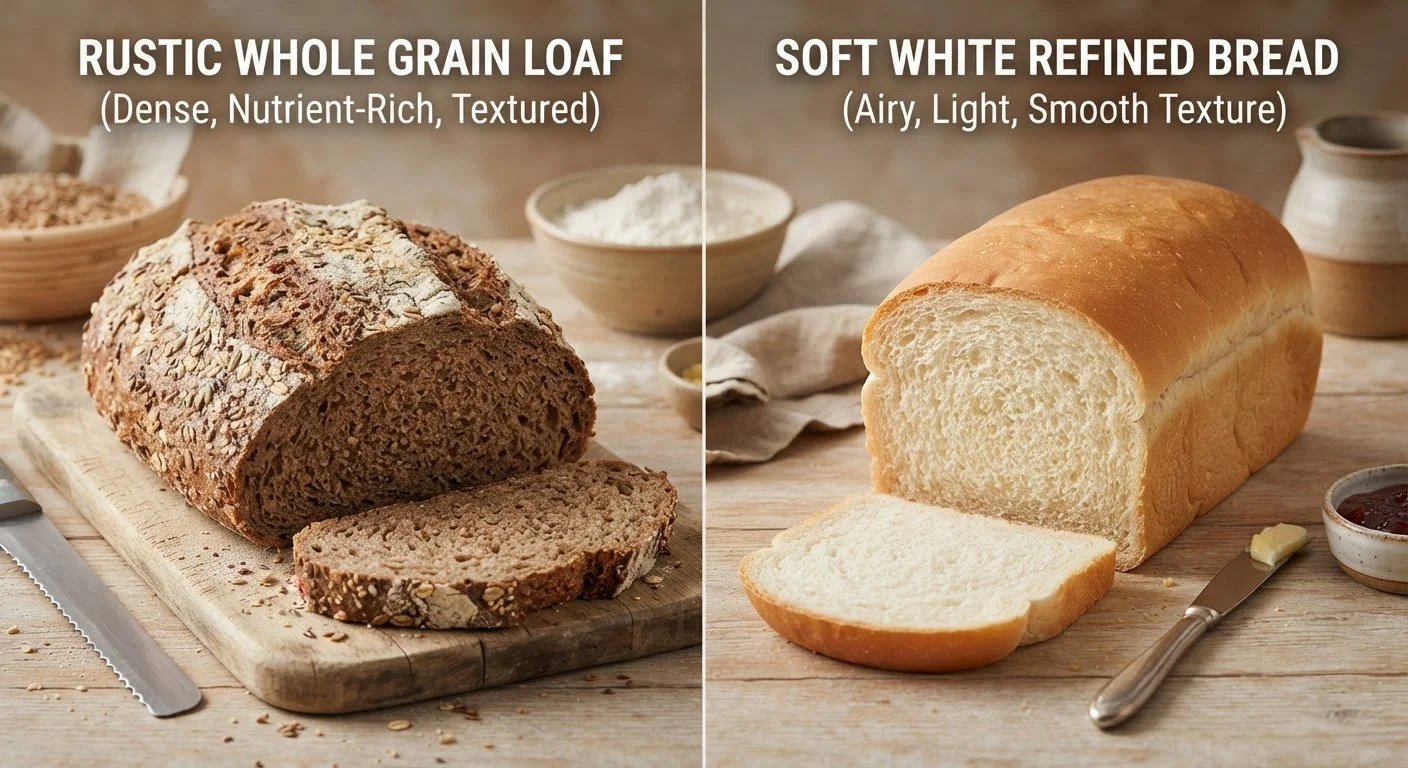
Photo: TheSearchHound.com | One Stop Answer To All Your Questions editorial
Key Takeaways
- Whole grains retain the bran, germ, and endosperm; refined grains have the bran and germ removed during milling.
- The milling process strips away fiber, B vitamins, iron, and other key micronutrients from refined grains.
- Dietary guidelines generally recommend making at least half of daily grain servings whole grains.
- Refined grains are often enriched with some B vitamins and iron, but fiber is typically not added back.
- Switching to whole grains is associated with lower risk of heart disease, type 2 diabetes, and digestive issues.
- Reading ingredient lists carefully is the most reliable way to identify true whole grain products.
What Separates Whole Grains from Refined Grains
Every grain kernel is made up of three layers: the bran (the fibrous outer shell), the germ (the nutrient-rich embryo), and the endosperm (the starchy inner core). A whole grain keeps all three layers intact. A refined grain, by contrast, has been milled to remove the bran and germ, leaving only the endosperm.
That milling process dramatically changes the nutritional profile. The bran delivers dietary fiber, B vitamins such as thiamin and niacin, and trace minerals. The germ contributes healthy fats, vitamin E, and additional B vitamins. When both are removed, the resulting product - white flour, white rice, or similar refined staples - is softer, has a longer shelf life, and has a milder flavor, but it is significantly lower in nutrients.
Many refined grain products in the U.S. are enriched, meaning manufacturers add back some B vitamins (thiamin, riboflavin, niacin, folic acid) and iron after milling. This is a meaningful step, but it does not replace everything lost - dietary fiber, in particular, is generally not restored.
| Criterion | Whole Grains | Refined Grains |
|---|---|---|
| Grain layers retained | Bran, germ, and endosperm | Endosperm only |
| Dietary fiber content | High | Low (unless added) |
| B vitamins | Naturally present | Partially restored via enrichment |
| Minerals (iron, magnesium) | Higher amounts | Reduced; iron often added back |
| Glycemic response | Generally lower | Generally higher |
| Shelf life | Shorter (due to oils in germ) | Longer |
| Common examples | Oats, brown rice, whole wheat bread | White bread, white rice, most pastries |
What the Research Says About Health Outcomes
A substantial body of nutrition research links regular whole grain consumption to several measurable health benefits. Studies published in journals such as the British Medical Journal and The Lancet have associated higher whole grain intake with lower risks of cardiovascular disease, type 2 diabetes, and colorectal cancer. These associations held even after adjusting for other lifestyle factors.
The fiber in whole grains plays a central role. Soluble fiber - found in oats and barley, for example - can help moderate LDL cholesterol levels. Insoluble fiber, present in wheat bran, supports digestive regularity. Both types feed the gut microbiome, the community of bacteria in your intestines that is increasingly recognized as important to overall health.
~30%
Reduced cardiovascular disease risk
A large meta-analysis in the BMJ found that eating 70g of whole grains per day was associated with roughly a 22-33% lower risk of cardiovascular disease compared to little or no whole grain intake.
5%
U.S. adults meeting whole grain recommendations
Research published in Nutrients found that fewer than 5% of American adults consistently meet federal recommendations for whole grain intake.
25%
Fiber reduction after milling
Milling wheat into refined white flour can remove up to 75-80% of its fiber content, according to grain processing research from multiple academic sources.
Refined grains, while not inherently harmful in moderate amounts, don't offer the same protective associations. Diets heavy in refined grains - particularly when combined with added sugars and saturated fats - are linked in population studies to higher rates of metabolic syndrome and obesity. Context matters: a single slice of white bread is not a health crisis, but a diet built predominantly around refined grains over time is a different picture.
It's worth noting that research in this area relies heavily on observational studies, which can identify associations but not prove direct causation. People who eat more whole grains also tend to have other health-promoting habits. Still, the consistent direction of the evidence supports current dietary guidelines favoring whole grains.
How to Identify and Incorporate Whole Grains
Food labeling can be genuinely confusing in this area. Terms like "multigrain," "made with whole grain," or "wheat bread" don't guarantee a product is primarily whole grain. The most reliable approach is to check the ingredient list: the first ingredient should say "whole wheat," "whole oats," "whole rye," or another whole grain, with the word whole explicitly included. Our guide on reading a nutrition label without getting lost in the fine print can help you interpret ingredient lists and other label details more confidently.
Common whole grain options include oatmeal, brown rice, quinoa, whole wheat bread and pasta, barley, and popcorn (yes, popcorn is a whole grain). Most of these are widely available and adaptable to everyday cooking.
Dietary guidelines from the U.S. Department of Agriculture recommend that at least half of all grains consumed daily come from whole grain sources. For most adults, that translates to roughly three to five servings of whole grains per day, though individual needs vary. Rather than overhauling your entire diet at once, small, consistent swaps - oatmeal instead of sugary cereal, brown rice instead of white - tend to be more sustainable over the long term.
This article is for general informational and educational purposes only and is not a substitute for professional medical or dietary advice. Consult a qualified healthcare provider or registered dietitian for guidance tailored to your individual health needs.
The content on this site is provided for informational purposes only and should not be considered a substitute for professional advice. While we strive to provide accurate and up-to-date information, we make no guarantees regarding its completeness or accuracy. Always consult a qualified professional for advice specific to your circumstances before making any decisions.