
Stacking Savings: How Coupons, Cashback, and Store Sales Work Together

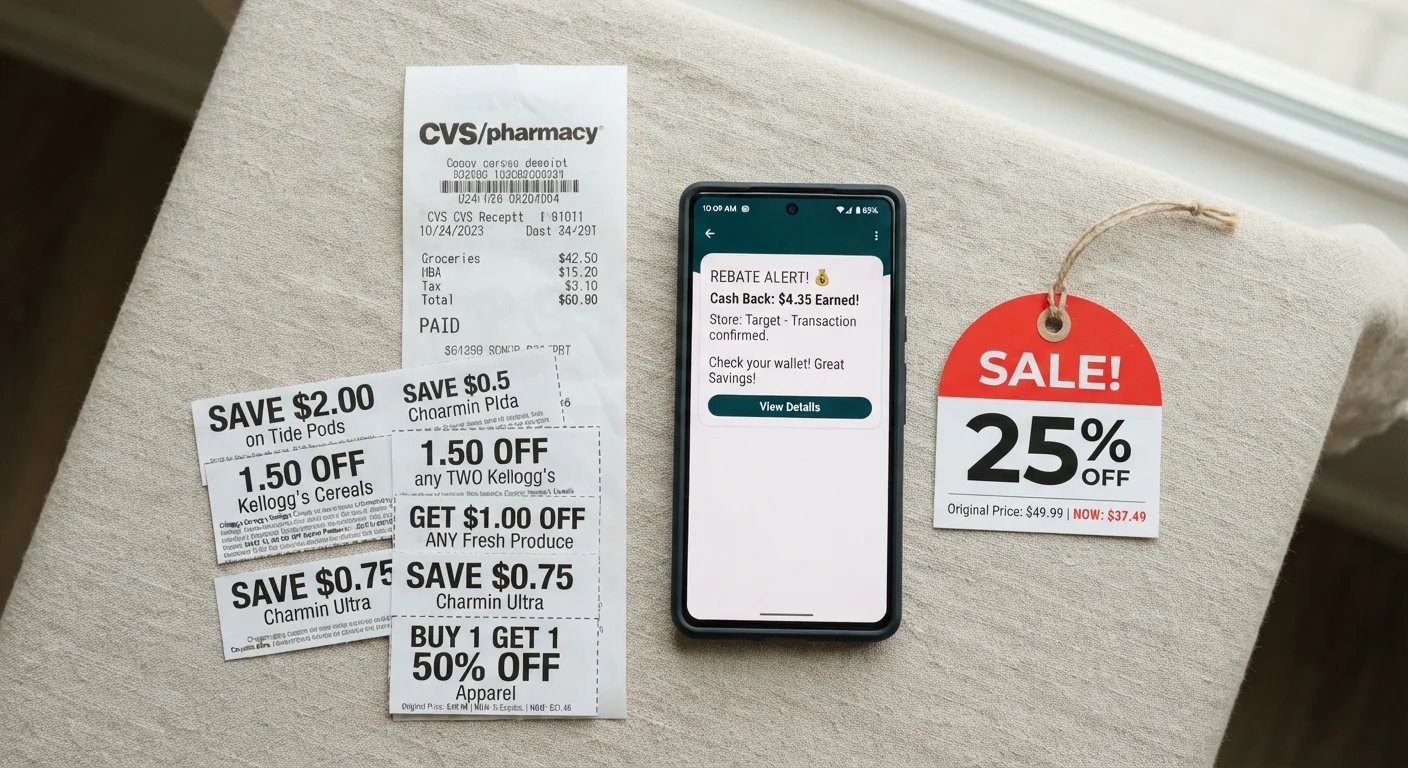
Photo: TheSearchHound.com | One Stop Answer To All Your Questions editorial
Key Takeaways
- Stacking savings means combining coupons, cashback, and store sales on the same purchase in the right order.
- Not all discount types can be combined - retailer policies and coupon terms set the rules.
- Cashback is typically applied after the final purchase price, so it layers cleanly on top of other discounts.
- Inflated 'original' prices can make a deal look bigger than it actually is - always verify with a baseline price.
- A modest, genuine discount on something you planned to buy beats a large discount on something you didn't need.
What 'Stacking' Actually Means
Savings stacking refers to applying multiple discount mechanisms to a single purchase so each one reduces the price independently. The three most common layers are manufacturer or retailer coupons, store sale pricing, and cashback programs. When used correctly and within each program's terms, these can compound into a meaningful reduction on items you were already planning to buy.
Understanding the mechanics matters because each layer operates differently. A store sale adjusts the shelf or listed price. A coupon subtracts a fixed amount or percentage from that price at checkout. Cashback - whether through a credit card, a browser extension, or a cashback app - returns a portion of what you actually paid, calculated after all other discounts have been applied. That sequencing is what makes stacking possible: you're not double-dipping on the same discount, you're layering distinct mechanisms in a defined order.
Before you start, it's worth understanding what distinguishes a genuine stacking opportunity from a marketing tactic designed to look like one. Retailers sometimes inflate a "was" price to make a discount appear larger than it is. Comparing the sale price against a historical price - not a reference price set by the retailer - gives you a more honest baseline. See our guide to comparing in-store and online prices for a closer look at how reference pricing can mislead shoppers.
Loyalty Programs Add Another Layer
What You'll Need Before You Start
Stacking savings isn't complicated, but it does require a few accounts and habits in place before you can do it consistently.
What you will need
Once these are in place, the process of stacking becomes largely routine rather than a research project each time you shop.
Step-by-Step: How to Stack on a Single Purchase
The steps below apply broadly to both in-store and online purchases, though the exact mechanics will vary by retailer. Always read the terms of each coupon or promotion before assuming it can be combined - some explicitly exclude stacking, and ignoring that can result in the discount being voided at checkout.
Confirm the item's baseline price
Before applying any discount, check what the item normally sells for at one or two other retailers or using a price-tracking tool. This gives you a real benchmark so you can judge whether the "sale" price is a genuine reduction or a reference-price markup.
Check for an active store sale or promotion
Visit the retailer's sale or promotions page and confirm whether the specific item - not just its category - is discounted. Note the sale end date, any quantity limits, and whether the discount requires a loyalty account to unlock.
Locate applicable coupons and verify their terms
Search for manufacturer coupons (issued by the brand) and retailer coupons (issued by the store) separately - many retailers allow one of each on a single item. Read the fine print: confirm the coupon applies to the exact product size, variety, or quantity you're buying, and check whether it can be combined with the current sale.
Activate cashback before you begin shopping
If you're using a cashback browser extension or app, activate it before you navigate to the product page or add items to your cart. Some programs require you to click through from their portal to the retailer's site for the cashback to track. Activating mid-session can cause tracking to fail.
Apply coupons at checkout and confirm the total
Enter coupon codes or clip digital coupons during checkout. Verify that each discount has been applied before completing the purchase - don't assume a code worked just because it was accepted. Review the order summary line by line: sale price, coupon reduction, and the final amount charged to your payment method.
Verify cashback has tracked correctly
After completing the purchase, check your cashback account within 24-48 hours to confirm the transaction appears and the amount matches what you expect. Cashback is typically calculated on the amount you paid (after coupons and sale pricing), not the original price. If it hasn't tracked, use the program's missing cashback claim process promptly - most have a window of 30-90 days.
For a broader pre-purchase habit, our pre-purchase savings checklist walks through additional steps worth taking before any significant purchase.
Stacking Has Real Limits - Read the Terms
Spotting Marketing Tactics vs. Real Savings
Discount stacking only works in your favor if the underlying price is legitimate. Several common retailer tactics can make an average deal look exceptional:
- Artificial reference prices: A product listed at "was $80, now $40" may have rarely or never sold at $80. Check a price-tracking tool or a competing retailer's current price for context.
- Coupon-triggered urgency: Time-limited coupons create pressure to buy before you've decided if you actually need the item. A coupon on something you wouldn't otherwise purchase isn't a saving - it's a spending trigger.
- Cashback on inflated prices: If a retailer raises a price before offering cashback through its own portal, the net savings may be identical to or less than simply buying elsewhere at the regular price.
The discipline of stacking is ultimately about planned purchases. The psychology of overspending during sales events explains why even deal-savvy shoppers can end up spending more than intended when discount signals are everywhere. Staying anchored to a purchase list protects you from that pattern.
If savings are part of a broader financial strategy - say, redirecting what you save toward debt repayment or an emergency fund - our article on balancing debt payoff and savings offers a practical framework for putting those freed-up dollars to work.
The content on this site is provided for informational purposes only and should not be considered a substitute for professional advice. While we strive to provide accurate and up-to-date information, we make no guarantees regarding its completeness or accuracy. Always consult a qualified professional for advice specific to your circumstances before making any decisions.