
Why "Verified Purchase" Reviews Aren't Always What They Seem

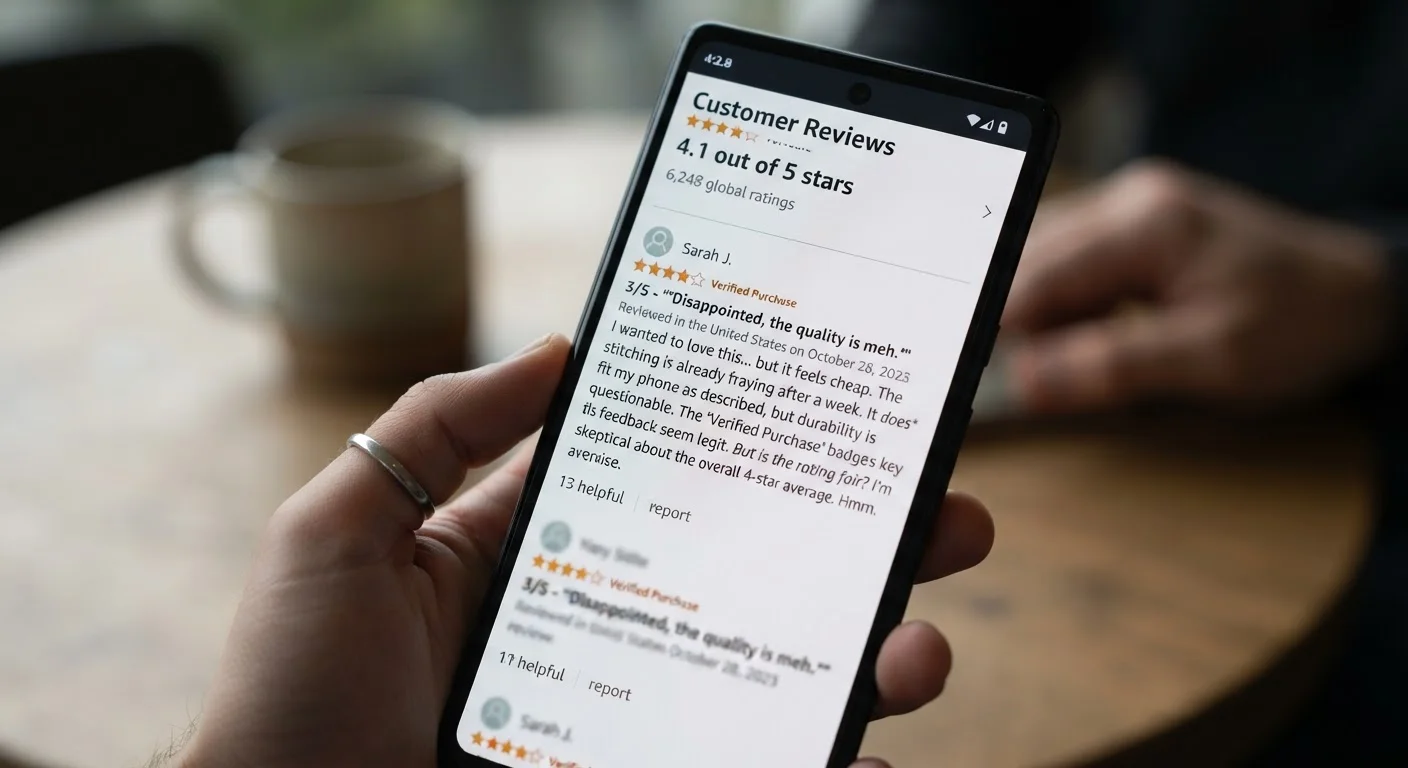
Photo: TheSearchHound.com | One Stop Answer To All Your Questions editorial
Key Takeaways
- Verified purchase labels confirm a transaction happened, not that the review is honest or unbiased.
- Incentivized reviews, returned products, and third-party seller manipulation can all produce verified badges.
- High review counts with a verified badge don't protect against coordinated review campaigns.
- Reading reviews critically - not just counting stars - is still the most reliable approach.
What the Verified Purchase Label Actually Confirms
The verified purchase badge, used by major e-commerce platforms including Amazon, is designed to distinguish reviewers who bought the product through that platform from those who didn't. On the surface, that sounds like a meaningful quality signal. In practice, it's a narrower confirmation than most shoppers assume.
The label confirms that a transaction was recorded - a payment was processed and associated with that account. It does not confirm that the reviewer used the product, that their experience was typical, or that they wrote the review independently. Those distinctions matter, and the gap between what the badge promises and what it delivers is where misconceptions take root.
For a fuller picture of how to evaluate reviews beyond the label alone, see how to read customer reviews without being misled.
Myth
A verified purchase badge means the reviewer genuinely used the product and wrote an honest opinion.
Fact
It only confirms that a purchase was made through the platform - not that the review is unbiased, independent, or even written after meaningful use.
Platforms tie the badge to a transaction record, not to the content or circumstances of the review. A buyer who received a discount code in exchange for a positive review, or who returned the product the next day, can still display the verified badge. The label is a transaction marker, not a credibility certification.
Myth
Products with thousands of verified reviews are too popular to have manipulated feedback.
Fact
High review volume can actually make manipulation harder to detect, not less likely to occur.
Coordinated review campaigns deliberately target volume as cover - a few hundred incentivized reviews are less visible when buried in thousands. Platforms like the FTC have taken enforcement action against review brokers operating at scale, which suggests the practice is common enough to warrant regulatory attention. A high count signals marketplace visibility, not review authenticity.
Myth
If a platform removes fake reviews, the remaining verified ones must be trustworthy.
Fact
Platforms acknowledge that detection is imperfect, and removal systems are reactive - they catch some manipulation after the fact, not all of it in real time.
Even the largest platforms use a combination of algorithmic detection and human review to identify and remove fraudulent content. Both methods have documented gaps. Reviews that pass detection may still reflect incentivized or coordinated activity that didn't trigger the platform's filters. Removal is a useful safeguard, not a guarantee.
Myth
Unverified reviews are less useful than verified ones and should be ignored.
Fact
Unverified reviews can carry genuinely useful information, particularly long-form feedback from domain experts or frequent buyers who purchased through other channels.
Someone who bought a product through a corporate account, as a gift, or from a physical retailer won't carry a verified badge for an online review - but their experience is still real. Dismissing all unverified reviews means filtering out a segment of legitimate feedback. The more useful filter is the quality and detail of the content, not the badge status alone.
How Verified Reviews Can Still Be Manipulated
Understanding the badge's limits isn't about cynicism - it's about accurate calibration. Several well-documented practices can produce verified purchase reviews that look legitimate but aren't independent.
42%
Online reviews estimated as potentially unreliable
A 2021 analysis by the World Economic Forum estimated that a significant share of online reviews across major platforms may be fake or incentivized, though exact figures vary by product category and platform.
$152M+
FTC penalties related to fake review enforcement
The U.S. Federal Trade Commission has pursued multiple enforcement actions and finalized rules targeting fake and incentivized reviews, with penalty authority designed to deter large-scale manipulation.
Reimbursement schemes: A seller may ask buyers to purchase a product at full price, leave a review, and then receive a refund or gift card through a third-party channel. The transaction is real; the independence is not. While platforms prohibit this practice, enforcement is reactive rather than preventive.
Return loopholes: Some platforms allow a verified badge to persist even if the customer later returned the item. A buyer who returned a product after one day can still carry a verified purchase tag on their review.
Seed accounts and bulk purchasing: Coordinated review networks sometimes use real accounts to make genuine purchases at scale, then post reviews from those accounts. The purchases are legitimate; the review program behind them is not.
These dynamics are also relevant when evaluating the seller behind a listing, not just the product itself. The guide on sizing up a seller before you buy covers additional red flags worth checking.
Incentivized Reviews Violate Platform Rules - But Still Happen
Reading Reviews More Effectively
The verified badge is one data point - useful, but not sufficient on its own. A few habits make review-reading significantly more reliable.
Look at the distribution, not just the average. A product with 4.3 stars might have a large spike at 5 stars and another at 1 star, with few in between. That pattern sometimes reflects a polarizing product or a review campaign that inflated the top end.
Filter for mid-range reviews. Three-star reviews are statistically less likely to be part of an incentivized campaign - they're too neutral to serve the seller's interest. They often contain the most detailed, honest observations about actual use.
Check the reviewer's profile. A reviewer who joined the platform last month and has left 40 five-star reviews across unrelated product categories is a different kind of signal than someone with a years-long, varied review history.
Cross-reference outside the platform. Independent forums, category-specific communities, and third-party review aggregators can surface consistent complaints or praise that platform reviews suppress or dilute.
Reviews are just one layer of due diligence. The way a product is photographed and described can be equally misleading - how product images can mislead and how to look past them is worth reading alongside your review research.
The content on this site is provided for informational purposes only and should not be considered a substitute for professional advice. While we strive to provide accurate and up-to-date information, we make no guarantees regarding its completeness or accuracy. Always consult a qualified professional for advice specific to your circumstances before making any decisions.