
Decoding Your Wireless Bill: What Every Line Item Actually Means

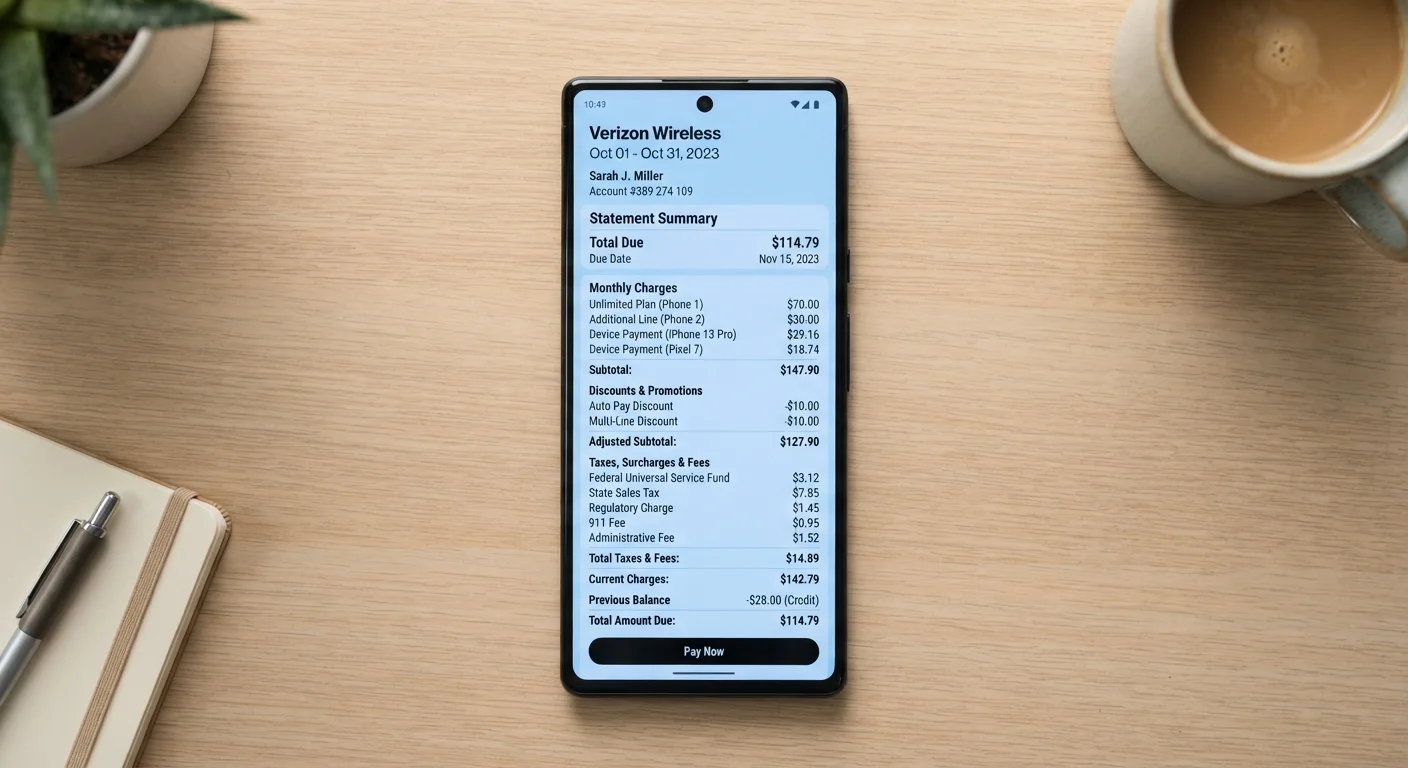
Photo: TheSearchHound.com | One Stop Answer To All Your Questions editorial
Key Takeaways
- Your base plan rate is just the starting point - taxes and fees routinely add 10-25% to that number.
- Government taxes on wireless service are mandatory and vary by state and municipality.
- Many surcharges listed on your bill are set by the carrier, not the government, even when their names sound official.
- Device installment charges are separate from your plan and reflect the financed cost of your phone.
- Understanding each line item makes it easier to spot errors and compare true costs across carriers.
The Base Plan Charge: What You're Actually Paying For
The base plan charge is the headline rate - the number most prominently advertised. It covers your core wireless service: voice calls, text messaging, and a defined amount of data (or unlimited data subject to network management rules). This line item reflects the tier of service you selected.
What it does not include is nearly everything else on your bill. Carriers advertise base plan costs because that's the number they control and can make look competitive. Everything added on top is disclosed separately, often in fine print. If you're comparing plans across carriers, the base plan rate is a starting point - not the full picture. See our guide to prepaid vs. postpaid trade-offs for a closer look at how billing structures differ between plan types.
~22%
Average tax and fee burden on U.S. wireless bills
According to research by the Tax Foundation, combined federal, state, and local taxes and fees on wireless service average around 22% of the consumer's bill nationally.
Varies by 10%+
Wireless tax rate difference between states
The Tax Foundation has found that wireless tax and fee rates can differ by more than 10 percentage points between the lowest- and highest-taxing states, affecting what customers pay for identical plans.
24-36 months
Typical device installment plan length
Most major U.S. carriers structure device financing over 24 or 36 monthly installments, meaning the device charge remains on your bill for up to three years.
Government Taxes: The Non-Negotiable Portion
Several lines on your bill represent taxes required by federal, state, and local governments. These are not carrier inventions - they are legally mandated and vary significantly depending on where you live.
- Federal Excise Tax: A longstanding federal tax on local telephone service, currently set at 3% for applicable services.
- State and local sales taxes: Applied to wireless service at rates that differ by state and municipality. Some states tax wireless service at higher rates than general sales.
- 911 surcharge: A fee collected by state and local governments to fund emergency services infrastructure. The label and amount vary by jurisdiction.
- Universal Service Fund (USF) contribution: Funds programs that extend connectivity to rural areas, schools, libraries, and low-income households. The FCC sets the contribution factor; carriers determine how to pass the cost to customers.
Because these taxes are location-dependent, two people on identical plans can have meaningfully different monthly totals based solely on their zip code.
Carrier Fees and Surcharges: Where Things Get Murky
This is where many customers feel misled. Carrier-imposed fees often have official-sounding names - "regulatory recovery fee," "administrative charge," "network access fee" - that suggest a government origin. They are not government taxes. They are set by the carrier to recover operating costs or regulatory compliance expenses, and they generate revenue.
How to Tell a Tax from a Fee
Common carrier fees include:
- Administrative or regulatory recovery fee: A carrier-set charge, typically a few dollars per line, that offsets costs such as FCC licensing fees or number administration.
- Line access fee: Charged per device on your account to maintain network access, separate from your data plan cost.
- Activation or upgrade fee: A one-time charge when you start service or upgrade a device. Some carriers waive these; others do not.
Understanding that these fees are carrier-controlled - not government-mandated - is important when reviewing your bill or deciding whether to switch. If you share lines with family members, each line typically carries its own set of these fees. Our article on how family plan lines are structured breaks down how those costs stack up.
Device Installment Charges and Add-Ons
If you financed your phone through your carrier rather than paying upfront, a device installment charge appears as its own line. This is a loan repayment - typically spread over 24 or 36 months - and is entirely separate from your wireless service plan. The device charge continues until the phone is paid off or, in some lease arrangements, returned.
Add-on charges appear when you've enrolled in optional services: device protection plans, international calling packages, hotspot upgrades, or premium streaming add-ons. Each appears as a distinct line with its own label. If you see an add-on you don't recognize, it may have been bundled in at sign-up or added during a promotional offer.
For context on what to read carefully before enrolling in any carrier agreement, see our overview of mobile contract clauses worth reviewing.
Reviewing these charges annually - especially after promotions expire - is one of the most straightforward ways to ensure your bill reflects only what you actually use and want.
Frequently Asked Questions
The content on this site is provided for informational purposes only and should not be considered a substitute for professional advice. While we strive to provide accurate and up-to-date information, we make no guarantees regarding its completeness or accuracy. Always consult a qualified professional for advice specific to your circumstances before making any decisions.