
Risk and Return: The Trade-Off Every New Investor Should Understand

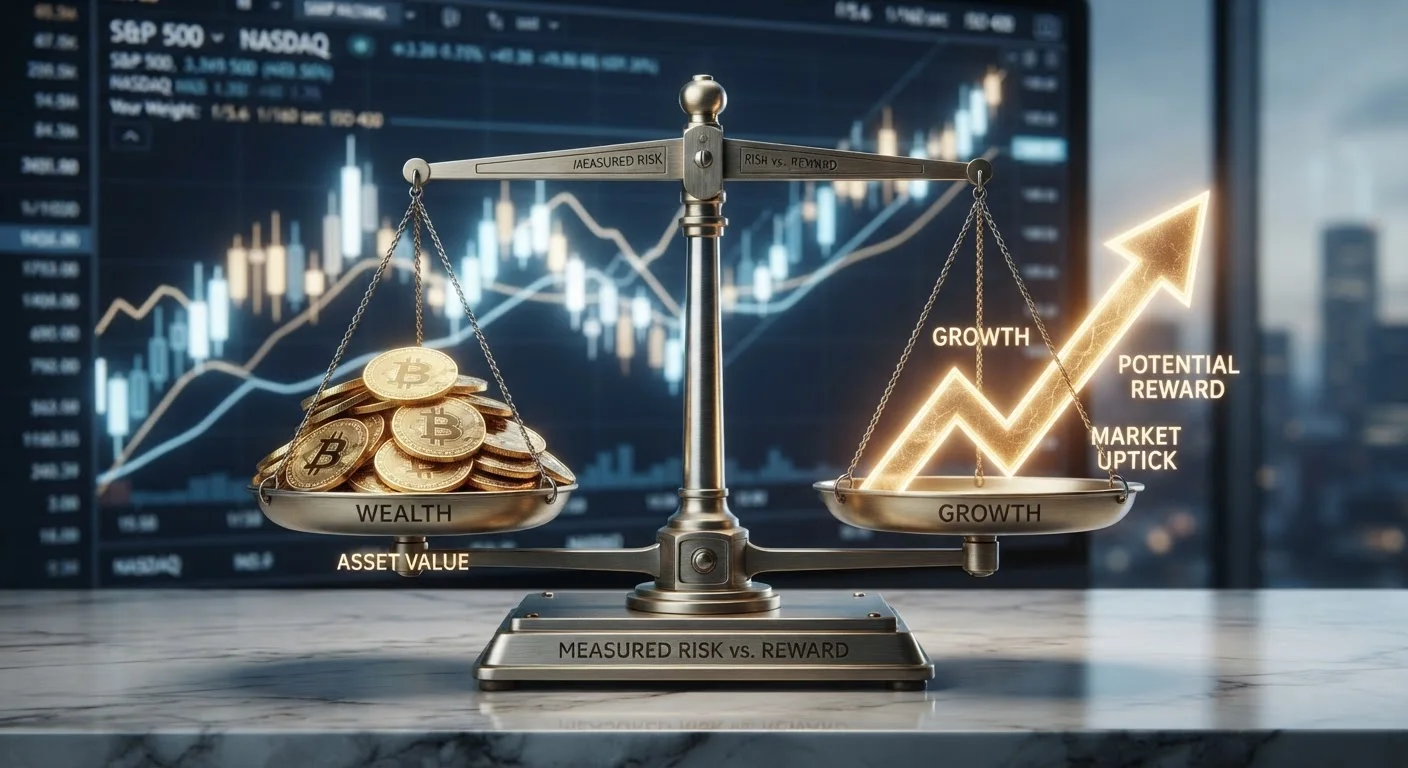
Photo: TheSearchHound.com | One Stop Answer To All Your Questions editorial
Key Takeaways
- Higher potential returns almost always require accepting higher potential losses.
- Risk is not inherently bad - it's the price investors pay for the opportunity to grow wealth.
- Your time horizon significantly shapes how much risk is appropriate for your situation.
- Diversification can help manage risk without necessarily sacrificing long-term return potential.
- There is no investment that offers high returns with zero risk - claims to the contrary are a red flag.
Why Risk and Return Are Always Linked
One of the first things worth understanding about investing is that risk and return are not two separate dials you can adjust independently. They move together. An investment offering the possibility of strong gains is also, by definition, one that could lose significant value. An investment that is very unlikely to lose value will, in turn, offer limited upside.
This isn't a flaw in the system - it's a feature of how markets work. Investors who take on more uncertainty need a meaningful reward to justify doing so. If a risky asset offered the same return as a virtually risk-free one, rational investors would simply choose the safer option, driving prices and yields toward equilibrium. The result is that riskier investments must offer the potential for higher returns to attract capital at all.
Understanding this dynamic helps explain why the promise of high returns with no risk - a common feature of investment fraud - should always trigger skepticism. As a general principle, if it sounds too good to be true, the risk-return relationship suggests it almost certainly is.
“Risk comes from not knowing what you're doing. The less you understand an investment, the riskier it becomes - regardless of what anyone calls it.”
— Warren Buffett, Chairman and CEO of Berkshire Hathaway, widely cited investor and author on value investing principles
Types of Investment Risk New Investors Should Know
The word "risk" in investing covers several distinct concepts, and it's useful to distinguish between them:
- Market risk: The possibility that the overall market declines, pulling down even well-chosen investments. This is sometimes called systematic risk because it affects virtually all assets.
- Concentration risk: The danger of having too much of your money in a single stock, sector, or asset type. If that holding drops sharply, the impact on your portfolio is magnified.
- Inflation risk: The risk that your returns don't keep pace with inflation, meaning your money loses purchasing power over time even if its nominal value holds steady.
- Liquidity risk: The possibility that you can't sell an investment quickly at a fair price when you need the cash.
Recognizing these different risk types matters because the right response to each is different. Concentration risk, for example, is directly addressed by spreading your investments across different assets. Inflation risk, by contrast, is often managed by holding some portion of a portfolio in assets historically capable of outpacing inflation over time.
~10%
Historical average annual U.S. stock market return
The S&P 500 has historically averaged roughly 10% annually before inflation, though individual years vary widely and past performance does not guarantee future results.
~4-5%
Historical average annual U.S. bond return
U.S. investment-grade bonds have historically offered lower but more stable returns than equities, reflecting their lower risk profile over comparable periods.
Over 50%
Peak S&P 500 decline during 2007-2009 crisis
The S&P 500 fell by more than 50% during the financial crisis - a stark reminder that market risk is real, even for broadly diversified index investors.
Time Horizon: The Factor That Changes Everything
One of the most practical insights about the risk-return trade-off is how dramatically your time horizon changes the picture. Short-term volatility - the kind that can feel alarming when you're watching a portfolio daily - tends to smooth out considerably over longer periods.
Historically, major stock market indices have experienced significant single-year losses but have also shown long-term upward trends over multi-decade periods. This doesn't guarantee future results, and past performance is not a reliable predictor of future returns. But it does illustrate why a 25-year-old saving for retirement and a 62-year-old approaching it face genuinely different risk conversations - even if their goal (financial security) is the same.
Longer time horizons give investors more opportunity to recover from downturns. This is part of why many financial professionals discuss shifting toward more conservative allocations as a person approaches a point when they'll need to draw on their investments. That said, the right balance is always personal - and worth discussing with a qualified financial adviser who understands your full picture.
If you're earlier in your investing journey, a first-timer's roadmap can help you think through the foundational decisions, including how to approach risk given your specific goals.
Applying the Trade-Off in Practice
Knowing the theory is useful. Knowing what to do with it is better. Here are a few ways the risk-return trade-off shows up in real investing decisions:
Asset allocation - how you divide your portfolio among stocks, bonds, cash, and other asset types - is one of the most direct expressions of where you sit on the risk-return spectrum. Stocks have historically offered higher long-term returns than bonds but also more volatility. Bonds tend to be more stable but offer lower growth potential. The proportion you hold of each reflects, in part, your risk tolerance and time horizon.
Individual stock selection is another area where the trade-off comes into sharp focus. A single company's stock can appreciate dramatically - but it can also fall to near zero. A balanced look at individual stock investing can help you think through whether that level of concentration risk fits your approach.
The trade-off also reinforces why compound growth over time is so powerful - staying invested and letting returns build on themselves can work in your favor, but only if the underlying risk level is one you can sustain without panic-selling during downturns.
Finally, even experienced investors make predictable errors around risk. Common beginner mistakes frequently involve either underestimating risk in pursuit of returns or avoiding all risk and inadvertently accepting inflation risk instead.
This article is intended for general informational and educational purposes only. It does not constitute personalized financial, investment, or tax advice. Please consult a qualified, licensed financial professional before making decisions based on your individual circumstances.
Frequently Asked Questions
The content on this site is provided for informational purposes only and should not be considered a substitute for professional advice. While we strive to provide accurate and up-to-date information, we make no guarantees regarding its completeness or accuracy. Always consult a qualified professional for advice specific to your circumstances before making any decisions.