
Saving vs. Investing: Choosing the Right Tool for the Right Goal

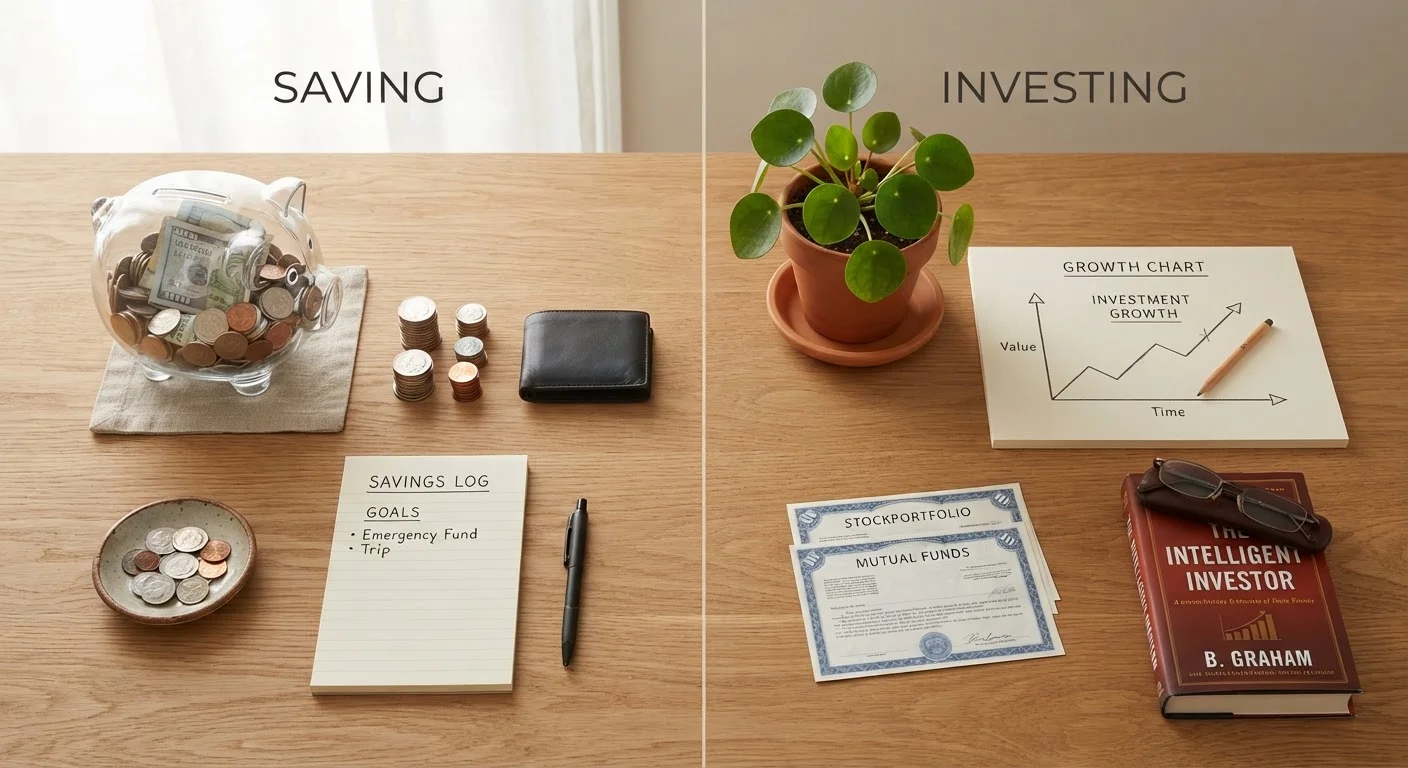
Photo: TheSearchHound.com | One Stop Answer To All Your Questions editorial
Key Takeaways
- Savings accounts protect your principal and keep money accessible; investment accounts aim to grow it over time.
- Your time horizon - how soon you need the money - is the most important factor in choosing between the two.
- Investing carries real risk of loss, especially in the short term; savings accounts are federally insured up to applicable limits.
- Most financial experts suggest having an emergency fund in savings before committing money to investments.
- Both tools can - and often should - work together as part of a broader personal financial plan.
What Each Tool Actually Does
Saving and investing are both ways to put money to work - but they operate by completely different rules. Understanding that distinction is the first step toward making smarter financial decisions.
A savings account holds money in a secure, federally insured account (up to applicable FDIC or NCUA limits) where it earns a modest, predictable interest rate. The balance doesn't fluctuate. You can withdraw funds at any time without penalty in most cases. The trade-off: interest rates on savings accounts rarely keep pace with inflation over the long run, which means the purchasing power of your money can gradually erode.
An investment account puts your money into assets - stocks, bonds, mutual funds, or exchange-traded funds (ETFs), for example - with the goal of growing it over time. Returns are not guaranteed, and the value of investments can fall as well as rise. However, historically, diversified investment portfolios have outpaced inflation significantly over long periods, making them a key tool for building wealth. For a broader look at how interest and growth work in your favor, see how compound interest works.
| Criterion | Savings Account | Investment Account |
|---|---|---|
| Primary purpose | Preserve and access money safely | Grow money over time |
| Return potential | Low, predictable interest rate | Higher potential, but variable |
| Risk of loss | Minimal (federally insured) | Real risk; value can decline |
| Ideal time horizon | Short-term (under 3 years) | Long-term (5+ years) |
| Liquidity | High - withdraw anytime | Varies; selling may take days |
| Inflation protection | Limited; may lose real value | Historically stronger over time |
| Complexity | Simple to open and manage | Requires more knowledge and decisions |
Time Horizon: The Deciding Factor
The single most important question when choosing between saving and investing is: When will you need this money?
If the answer is within the next one to three years - for a home down payment, a wedding, or an emergency cushion - saving is generally the appropriate tool. Markets can drop sharply in any given year, and a short time horizon leaves no room to wait for a recovery. Locking money into investments you might need soon introduces unnecessary risk to funds earmarked for specific, near-term purposes.
If your goal is five or more years away, investing becomes more appropriate. The longer your money stays invested, the more time it has to recover from downturns and compound its growth. Retirement, a child's education fund, and long-term wealth accumulation are classic cases where the math favors investing over keeping cash in a savings account.
3-6 months
Recommended emergency fund size
Most mainstream financial guidance suggests holding three to six months of essential living expenses in liquid savings before investing.
~10%
Average annual S&P 500 return (historical)
The S&P 500 index has historically averaged roughly 10% annually before inflation, though past performance does not predict future results.
2-3%
Average U.S. inflation rate (long-run)
The Federal Reserve targets 2% annual inflation; savings accounts earning below that rate lose real purchasing power over time.
It's also worth noting that these two tools are not mutually exclusive. Many households use both simultaneously - maintaining a savings account for near-term needs and emergencies while directing additional money into investment accounts for long-term goals. The Budgeting Basics hub can help you identify how much to allocate to each bucket.
Risk, Return, and What You Might Lose
Savings accounts carry virtually no risk of losing principal. Your deposited balance is federally insured (up to applicable limits), and interest, while modest, is predictable. The main risk is inflation risk - over many years, rising prices can erode the real value of money sitting in low-yield accounts.
Investment accounts carry market risk: the value of your holdings can decline, sometimes sharply and for extended periods. This is not a reason to avoid investing altogether - it is a reason to invest only money you won't need in the short term and to diversify appropriately. Risk tolerance, time horizon, and financial goals all factor into how an investment portfolio should be structured. Before opening any investment account, it's worth reviewing a practical checklist: things worth checking before you open an investment account.
One commonly cited starting principle: build an adequate emergency fund in savings - often three to six months of essential expenses - before directing money toward investments. Without that cushion, an unexpected job loss or medical bill could force you to sell investments at an inopportune moment. For a deeper look at structuring your savings, see the difference between a savings account and an emergency fund.
This article is for general informational and educational purposes only. It is not personalized financial, investment, tax, or legal advice. Past investment performance does not guarantee future results. Please consult a qualified, licensed financial professional before making decisions specific to your situation.
The content on this site is provided for informational purposes only and should not be considered a substitute for professional advice. While we strive to provide accurate and up-to-date information, we make no guarantees regarding its completeness or accuracy. Always consult a qualified professional for advice specific to your circumstances before making any decisions.