
How Compound Interest Works in Your Favor (and Against You)

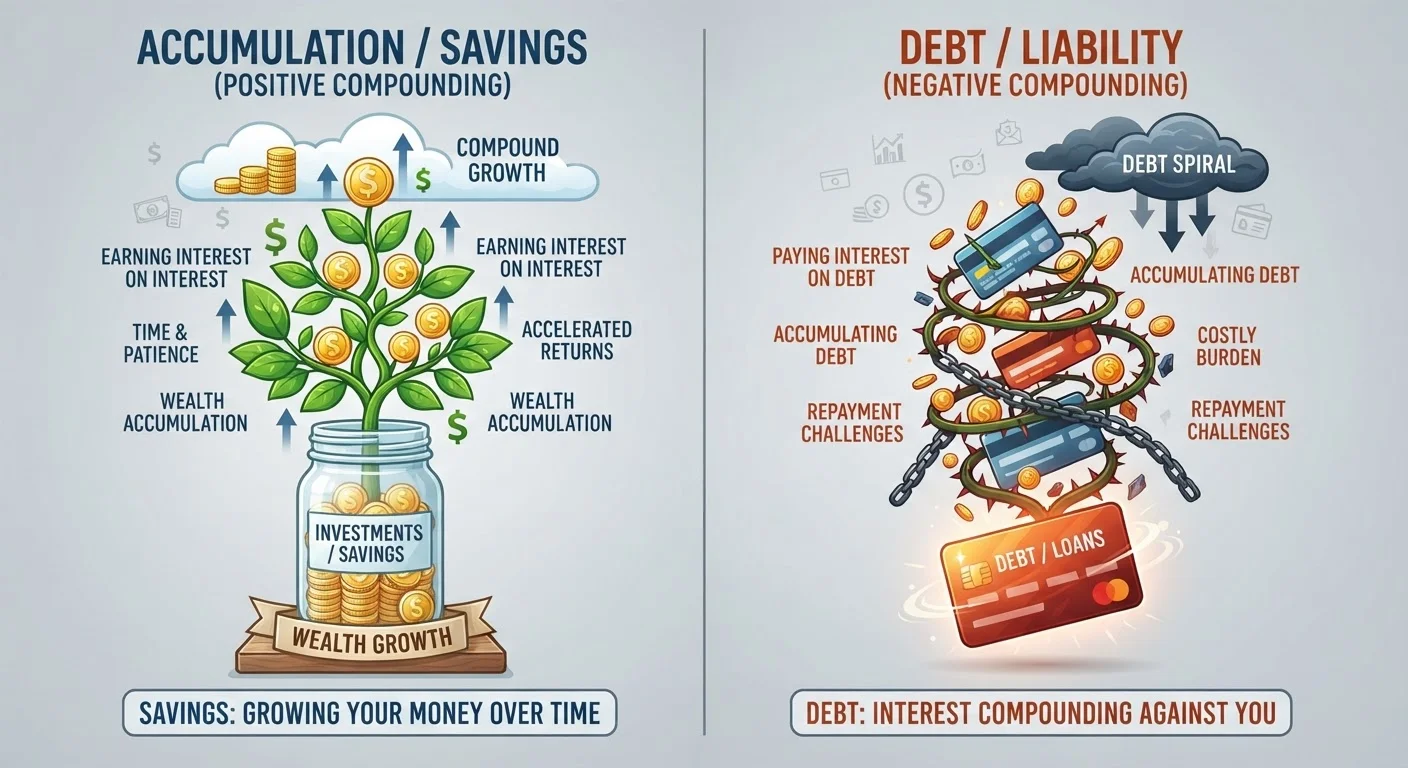
Photo: TheSearchHound.com | One Stop Answer To All Your Questions editorial
Key Takeaways
- Compound interest grows your balance faster than simple interest because earned interest itself earns more interest.
- Starting to save earlier makes a dramatic difference due to the time compounding needs to accelerate.
- High-interest debt compounds against you the same way savings compound for you.
- Paying only the minimum on revolving debt allows interest to snowball significantly over time.
- The compounding frequency - daily vs. monthly - affects your actual returns or costs.
The Core Mechanic: How Compounding Actually Works
At its simplest, compound interest means you earn (or owe) interest on a growing base - not a fixed one. Every time interest is added to your balance, that new, larger balance becomes the starting point for the next calculation.
Consider a straightforward illustration: you deposit $1,000 in a savings account earning 5% annual interest. After year one, you have $1,050. In year two, the 5% is applied to $1,050 - not the original $1,000 - giving you $1,102.50. That extra $2.50 might seem trivial, but stretch this out over 20 or 30 years and the cumulative effect becomes substantial.
For a deeper look at the mechanics alongside a glossary of related terms, see our plain-language glossary of saving and debt terms.
~$2,653
$1,000 at 5% over 20 years (compounded annually)
Illustrative calculation showing how $1,000 grows without any additional contributions - purely through compound interest over two decades.
20%+
Typical credit card APR range in the U.S.
Federal Reserve data has consistently shown average credit card interest rates above 20% in recent years, underscoring how quickly balances can compound against borrowers.
72 ÷ Rate
Years to double your money (Rule of 72)
A widely used estimation tool in personal finance that shows the direct relationship between interest rate and time required to double a balance.
Compound Interest Working For You: Saving and Investing
When you're building savings or investing for long-term goals, compound interest is one of the most reliable forces available. The key variables are the interest rate, the compounding frequency, and - most critically - time.
Time is the factor most within a saver's control. Someone who begins contributing to a retirement account in their mid-20s and earns a consistent average return will typically accumulate significantly more than someone who waits until their late 30s to start, even if the late starter contributes larger amounts annually. This is because early contributions have more compounding periods to build on.
Make Compounding Work Harder for You
The Rule of 72 offers a useful mental shortcut: divide 72 by your annual interest rate to estimate how long it takes your balance to double. At 6%, that's roughly 12 years. At 4%, about 18 years. It underscores why a higher rate - and more time - matters so much.
For guidance on which accounts and vehicles are appropriate for different goals, choosing the right savings or investment tool breaks down when each option fits best. And for a broader look at how compounding builds wealth over a lifetime, see compound interest as a long-term wealth-building force.
Compound Interest Working Against You: Debt
The same mathematical engine that builds savings can steadily erode your financial position when it applies to debt. High-interest revolving debt - credit cards being the most common example - compounds against you continuously.
When you carry a balance and make only minimum payments, a large portion of each payment covers interest rather than principal. Because the principal barely shrinks, the next month's interest calculation starts from nearly the same base. Over months and years, you can pay far more than you originally borrowed while the balance barely moves.
This is why the interest rate on debt deserves as much attention as the interest rate on savings. Understanding the pros and cons of debt consolidation can help you evaluate whether restructuring high-interest balances makes sense in your situation.
This article is for general informational and educational purposes only and does not constitute personalized financial, investment, tax, or legal advice. Consult a qualified financial professional before making decisions about your own financial circumstances.
Frequently Asked Questions
The content on this site is provided for informational purposes only and should not be considered a substitute for professional advice. While we strive to provide accurate and up-to-date information, we make no guarantees regarding its completeness or accuracy. Always consult a qualified professional for advice specific to your circumstances before making any decisions.