
Fixed-Rate vs. Adjustable-Rate Mortgages: Understanding the Trade-Offs

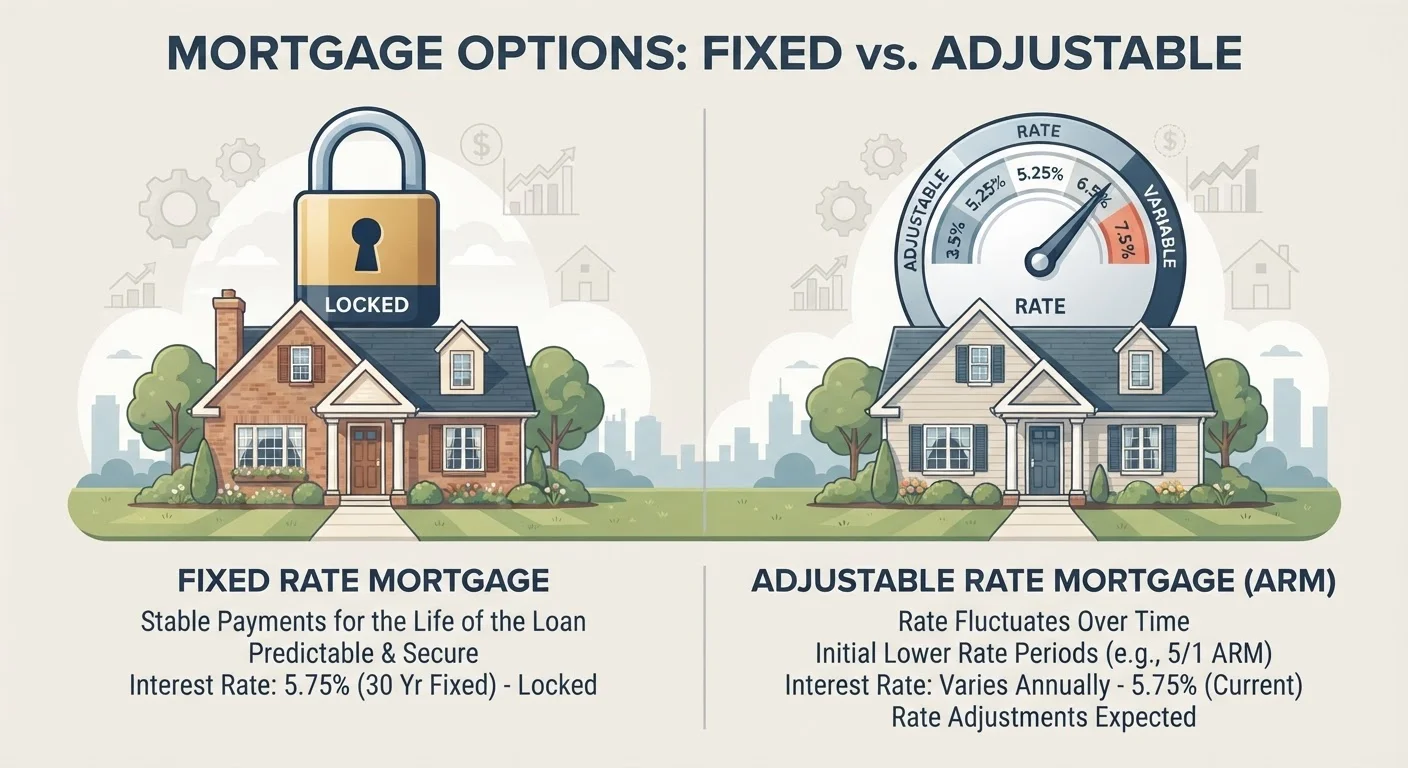
Photo: TheSearchHound.com | One Stop Answer To All Your Questions editorial
Key Takeaways
- Fixed-rate mortgages lock in your interest rate for the entire loan term, making monthly payments predictable.
- ARMs typically offer a lower initial rate that adjusts periodically based on a benchmark index after an introductory period.
- Fixed-rate loans generally cost more upfront but protect borrowers from rising rates over time.
- ARMs carry interest rate risk - payments can increase significantly if benchmark rates rise.
- Your expected time in the home is one of the most important factors in choosing between these structures.
- Consulting a licensed mortgage professional can help you model actual payment scenarios for your situation.
How Each Loan Structure Works
A fixed-rate mortgage charges the same interest rate for the entire repayment term - typically 15 or 30 years. Every monthly payment of principal and interest remains identical from the first payment to the last. The predictability this creates is its defining characteristic. Understanding how rate levels affect what you actually pay is covered in depth in our article on how interest rates shape housing affordability.
An adjustable-rate mortgage (ARM) starts with a fixed introductory period - commonly 5, 7, or 10 years - during which the rate stays stable and is usually lower than prevailing fixed rates. After that period, the rate adjusts at set intervals (often annually) based on a published benchmark index, plus a margin set by the lender. ARMs are typically labeled with two numbers, such as a 5/1 ARM: the first number indicates the fixed period in years, the second how often the rate adjusts afterward.
Lenders apply caps to limit how much an ARM rate can move. These include a periodic cap (how much the rate can change per adjustment), a lifetime cap (the maximum increase over the loan's life), and sometimes an initial adjustment cap. Even with caps, payments can still rise substantially.
| Criterion | Fixed-Rate Mortgage | Adjustable-Rate Mortgage (ARM) |
|---|---|---|
| Interest rate | Locked for entire loan term | Fixed initially, then adjusts periodically |
| Initial monthly payment | Higher than comparable ARM | Lower during introductory period |
| Payment predictability | Fully predictable throughout | Predictable only during fixed period |
| Interest rate risk | None - borrower fully protected | Borrower absorbs risk after fixed period |
| Common loan terms | 15-year, 30-year | 5/1, 7/1, 10/1 ARM structures |
| Best rate environment | Low or rising rate environments | High or falling rate environments |
| Ideal time horizon | Long-term ownership (10+ years) | Shorter-term ownership (under 7 years) |
Weighing the Trade-Offs
The central tension between these two loan types is certainty versus cost. Fixed-rate mortgages eliminate interest rate risk entirely - whatever happens to the broader rate environment, your payment doesn't change. That stability has value, especially for borrowers whose income is predictable or whose budgets have little slack. The concept applies broadly: understanding fixed versus variable expenses in your overall budget reveals why predictable housing costs can be an anchor for sound financial planning.
ARMs, meanwhile, transfer some interest rate risk from the lender to the borrower - in exchange for a lower starting rate. This is fundamentally a risk-return trade-off: the borrower accepts uncertainty in exchange for lower early costs. That dynamic mirrors broader investing principles explored in our piece on risk and return trade-offs.
30 years
Most common fixed-rate mortgage term in the US
The 30-year fixed-rate mortgage has historically been the dominant loan product in the American housing market, according to data from the Federal Housing Finance Agency.
~1-2%
Typical ARM introductory rate discount vs. fixed
ARMs have historically offered initial rates roughly 1 to 2 percentage points below comparable fixed-rate products, though this spread varies with market conditions.
5-6%
Typical ARM lifetime rate cap above initial rate
Most conventional ARMs include a lifetime cap limiting total rate increases to 5 or 6 percentage points above the initial rate, per standard lending guidelines.
The math depends heavily on how long you stay. If you sell before your ARM's fixed period ends, you capture the low-rate benefit without experiencing an adjustment. If you stay longer and rates have risen, your costs could significantly exceed what a fixed-rate loan would have cost over the same period. Modeling both scenarios using current rate quotes - not assumptions - is essential before choosing.
Loan type also interacts with loan program. Whether you're considering conventional financing or government-backed options, both fixed and adjustable structures can be available. Our side-by-side comparison of conventional, FHA, VA, and USDA loans explains how eligibility and structure intersect across programs.
Lenders also evaluate your debt-to-income ratio when qualifying you for either loan type - and may use the fully adjusted ARM rate, not the teaser rate, in those calculations.
This article is for general informational and educational purposes only. It is not personalized financial or mortgage advice. Consult a licensed mortgage professional or financial adviser before making borrowing decisions based on your specific circumstances.
The content on this site is provided for informational purposes only and should not be considered a substitute for professional advice. While we strive to provide accurate and up-to-date information, we make no guarantees regarding its completeness or accuracy. Always consult a qualified professional for advice specific to your circumstances before making any decisions.