
Fiber vs. Cable Internet: Which Delivers More for Most Households

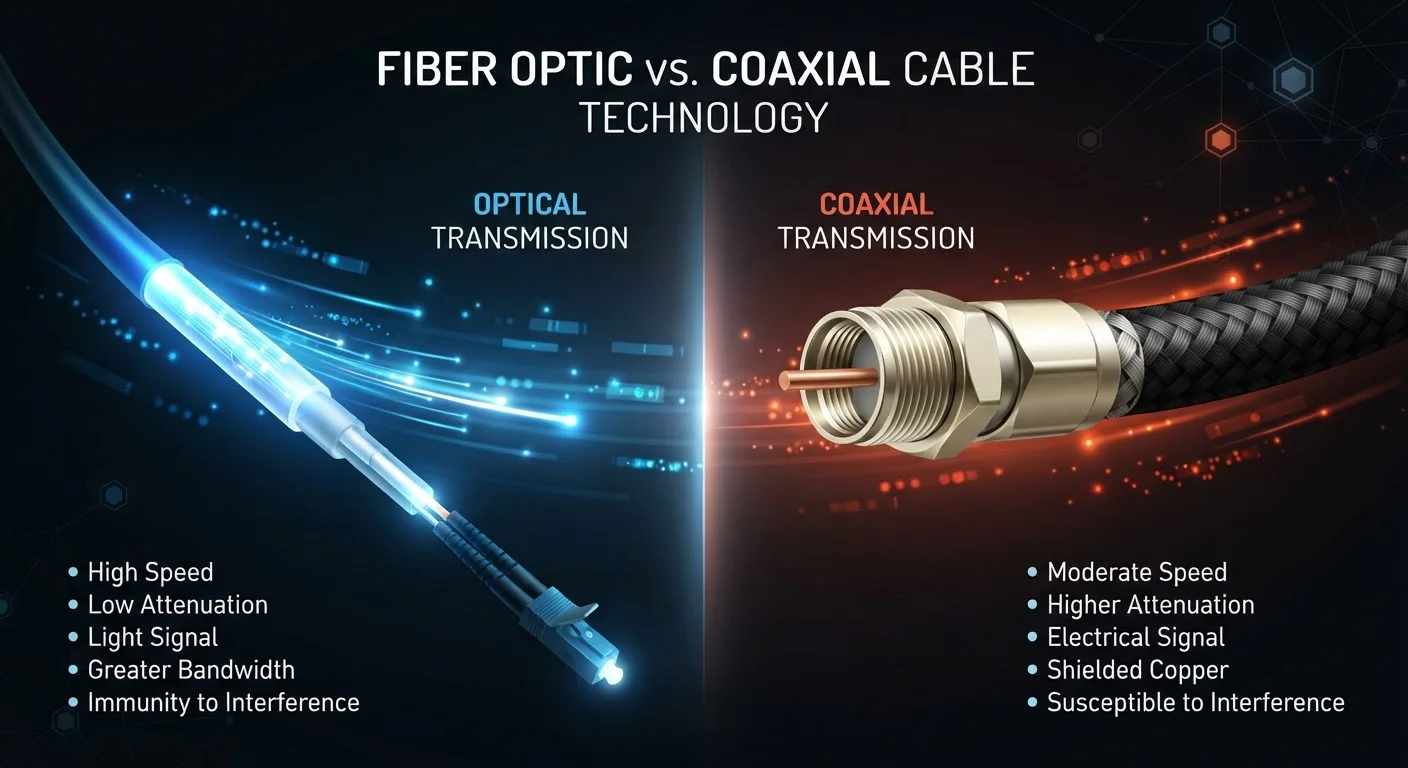
Photo: TheSearchHound.com | One Stop Answer To All Your Questions editorial
Key Takeaways
- Fiber uses light signals through glass strands; cable uses electrical signals through coaxial copper lines.
- Fiber offers symmetrical upload and download speeds; cable upload speeds are typically much slower than downloads.
- Cable internet is available to roughly 89% of U.S. households; fiber coverage is expanding but remains less universal.
- Fiber connections are generally more stable under heavy network congestion than shared cable infrastructure.
- Both technologies can deliver speeds sufficient for most households, but the right fit depends on your usage patterns.
How Each Technology Actually Works
Understanding the real-world differences between fiber and cable internet starts with the physical infrastructure each relies on. Fiber-optic internet transmits data as pulses of light through thin glass or plastic strands. Because light travels with minimal signal degradation over long distances, fiber connections maintain consistent speeds regardless of how far a household sits from the provider's central hub.
Cable internet, by contrast, sends data as electrical signals through coaxial cable - the same type of copper-and-shielding wire originally built for television distribution. This infrastructure is already wired into most American neighborhoods, which is a key reason cable internet is so widely available. However, electrical signals are more susceptible to interference and attenuation over distance than light signals are.
For a broader overview of how these and other connection types fit into the home internet landscape, see our plain-language guide to broadband types and speeds.
| Criterion | Fiber Internet | Cable Internet |
|---|---|---|
| Signal medium | Light through glass or plastic strands | Electrical signal through coaxial copper |
| Upload vs. download speed | Symmetrical (equal both ways) | Asymmetrical (uploads much slower) |
| Congestion sensitivity | Lower - dedicated signal paths | Higher - shared neighborhood infrastructure |
| Household availability (U.S.) | Expanding, less universal | Broadly available (~89% of households) |
| Latency | Typically lower | Moderate; can spike under congestion |
| Maximum speeds available | Up to multi-gigabit on some plans | Up to gigabit on some plans |
| Infrastructure age | Newer build-outs in most areas | Established; some lines decades old |
Speed, Symmetry, and Congestion: The Practical Differences
On paper, both fiber and cable can advertise fast speeds - sometimes gigabit-level plans. The more meaningful distinction is symmetry. Fiber plans typically offer equal upload and download speeds. Cable plans are engineered to prioritize downloads, often delivering upload speeds that are a fraction of the advertised download rate. For a household that primarily consumes content - streaming movies, browsing - this asymmetry may go unnoticed. For remote workers uploading documents, content creators sending large files, or households with frequent video calls, upload speed becomes a real constraint.
Congestion is another differentiator. Cable infrastructure in most neighborhoods is shared - multiple households draw from the same physical line segment. During peak usage hours (typically evenings), this shared bandwidth can cause noticeable slowdowns. Fiber infrastructure is designed differently and is generally less susceptible to neighborhood-level congestion, though provider network capacity still affects performance.
~89%
U.S. households with cable internet access
According to FCC broadband deployment data, cable infrastructure covers the large majority of American homes, reflecting its long-established coaxial TV network foundation.
~43%
U.S. households with fiber internet access
Fiber availability has grown substantially but still covers less than half of U.S. locations, with deployment accelerating through infrastructure investment programs.
10x+
Typical fiber upload speed advantage over cable
On comparable advertised download tiers, fiber upload speeds often exceed cable upload speeds by a factor of ten or more due to symmetrical network design.
If your area has limited options, our comparison of fiber, cable, DSL, and fixed wireless can help you evaluate the full range of available alternatives.
Availability, Infrastructure, and What to Check in Your Area
Availability remains one of the most decisive factors for most households - not because one technology is clearly superior, but because one may simply not be an option yet. Cable internet infrastructure, built largely on existing coaxial TV networks, covers the substantial majority of U.S. households, including most suburban and urban areas. Fiber coverage has grown considerably in recent years, driven by both private investment and public funding initiatives, but significant gaps persist, particularly in rural and lower-density communities.
Before comparing plans, it's worth verifying what's actually serviceable at your address - provider coverage maps can be helpful starting points, though confirmed availability at the street level is what ultimately matters. Local or state broadband maps, as well as the FCC's national broadband map, can supplement provider-provided information.
Cost can also vary by region and provider. For households where affordability is a concern, it's worth exploring whether you qualify for assistance. Our overview of internet access programs for lower-income households explains how several federal and state programs are structured.
Fiber Availability Is Expanding Rapidly
Once you have service, the equipment connecting your home to that service also affects your experience. Our guide on renting versus owning your router and modem lays out the trade-offs honestly.
The content on this site is provided for informational purposes only and should not be considered a substitute for professional advice. While we strive to provide accurate and up-to-date information, we make no guarantees regarding its completeness or accuracy. Always consult a qualified professional for advice specific to your circumstances before making any decisions.