
Furnace vs. Heat Pump: Understanding How Each Heats Your Home

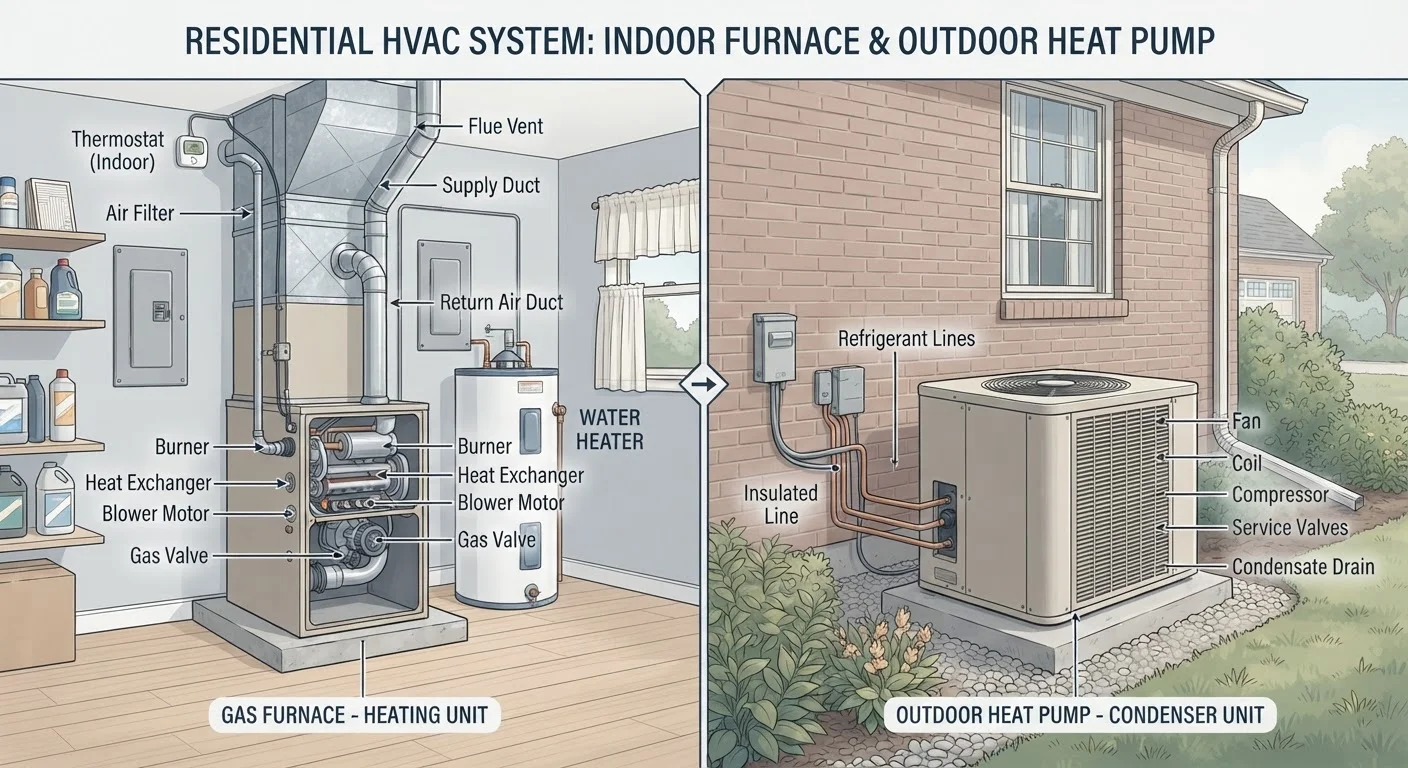
Photo: TheSearchHound.com | One Stop Answer To All Your Questions editorial
Key Takeaways
- Furnaces generate heat by burning fuel; heat pumps transfer heat from outdoor air into your home.
- Heat pumps can be significantly more energy-efficient in mild to moderate climates.
- Furnaces maintain reliable output even when outdoor temperatures drop well below freezing.
- Both systems require regular filter changes and annual professional inspections.
- Climate, existing ductwork, and local energy costs are the main factors in choosing between them.
How Each System Actually Produces Heat
The core difference between a furnace and a heat pump comes down to one word: generation versus transfer.
A gas furnace burns fuel - most commonly natural gas, though propane and oil furnaces exist - inside a heat exchanger. The combustion process produces hot gases that warm the exchanger, and a blower fan pushes air across that surface and into your duct system. The byproduct gases are vented safely outside. Because furnaces create heat directly, they can produce very high outlet air temperatures - typically in the 120°F-140°F range - even when it is bitterly cold outdoors.
A heat pump works on the same principle as a refrigerator, just in reverse. It uses a refrigerant cycle to absorb heat energy from outdoor air (or the ground, in the case of geothermal systems) and concentrate that heat before releasing it inside your home. In summer, the cycle reverses to pull heat out of your home and release it outdoors - effectively acting as an air conditioner. Because the system is moving heat rather than combusting fuel, it can deliver more energy than it consumes in electricity, especially in temperatures above roughly 35°F-40°F.
| Criterion | Gas Furnace | Heat Pump |
|---|---|---|
| Heat source | Combustion (gas, propane, or oil) | Outdoor air (or ground) heat transfer |
| Efficiency metric | AFUE (up to ~98%) | COP / HSPF (can exceed 200-300%) |
| Cold-weather performance | Consistent at any outdoor temp | Declines below ~35°F; varies by model |
| Cooling capability | None (needs separate AC unit) | Yes - reverses cycle for cooling |
| Energy source | Natural gas, propane, or oil | Electricity |
| Typical lifespan | 15-20 years | 10-15 years |
| Annual maintenance | Flue, burners, heat exchanger, filter | Coils, refrigerant, outdoor unit, filter |
Efficiency, Performance, and Climate Limits
Furnace efficiency is measured by AFUE - the percentage of fuel converted to usable heat. Modern high-efficiency furnaces typically reach 95-98% AFUE, meaning very little fuel is wasted. However, that figure still describes a system creating heat from a finite fuel source.
Heat pump efficiency is expressed as a COP or a seasonal rating (HSPF). A heat pump with a COP of 3 delivers three units of heat for every one unit of electricity consumed - an effective efficiency of 300%. That advantage narrows as outdoor temperatures fall, because there is less ambient heat available to extract. Older heat pump models struggled significantly below about 25°F. Many modern cold-climate heat pumps now maintain useful output down to 0°F or lower, though efficiency still declines at the extremes.
95-98%
AFUE for modern high-efficiency furnaces
The U.S. Department of Energy notes that high-efficiency condensing furnaces convert nearly all fuel to usable heat, compared to older models at 56-70% AFUE.
2-3x
Heat energy delivered per unit of electricity
The U.S. Department of Energy states that heat pumps can deliver two to three times more heat energy than the electrical energy they consume, under suitable outdoor conditions.
Homes in the upper Midwest, Mountain West, and northern New England - where temperatures regularly stay below 20°F for extended periods - have historically favored furnaces for this reason. Homes in the South, Pacific Northwest, and mid-Atlantic states often see heat pumps perform well year-round. Good attic insulation also plays a major role in how hard either system has to work - see our guide on attic insulation and ventilation for more on that.
Routine Maintenance: What Each System Needs
Both systems share one universal requirement: clean air filters. A clogged filter restricts airflow, forces the system to work harder, and accelerates wear on components. Most standard filters should be checked monthly and replaced every one to three months depending on household conditions. Our overview of HVAC filter ratings explains how to choose the right filter without restricting airflow unnecessarily.
Furnace-specific maintenance includes checking the flue and venting for blockages or corrosion, inspecting the heat exchanger for cracks (a cracked exchanger can allow carbon monoxide to enter living spaces - this requires a professional), and ensuring the burners are clean and igniting correctly. A licensed HVAC technician should inspect a gas furnace annually before heating season.
Heat pump maintenance involves keeping the outdoor unit clear of debris, leaves, and ice buildup. The coils should be cleaned periodically, and refrigerant levels should be checked by a certified technician - refrigerant handling requires professional credentials. Because a heat pump is also your cooling system, scheduling a professional tune-up in spring (before cooling season) and fall (before heating season) is advisable.
Pairing either system with a well-programmed thermostat can reduce unnecessary runtime. Smart thermostats can help automate temperature setbacks, though their impact depends heavily on how well the home is insulated and sealed.
The content on this site is provided for informational purposes only and should not be considered a substitute for professional advice. While we strive to provide accurate and up-to-date information, we make no guarantees regarding its completeness or accuracy. Always consult a qualified professional for advice specific to your circumstances before making any decisions.