
Driving in Rain, Snow, Ice, and Fog: What Changes and What Doesn't

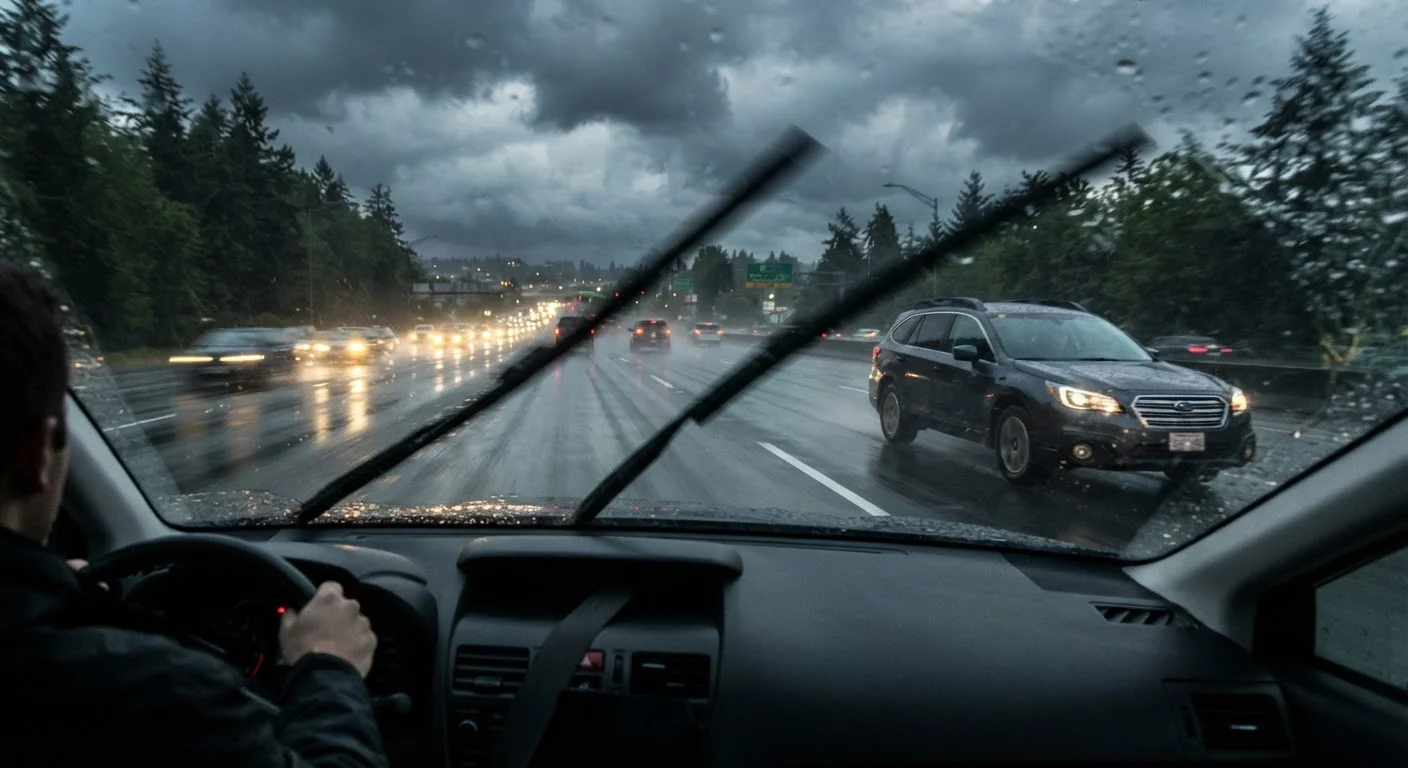
Photo: TheSearchHound.com | One Stop Answer To All Your Questions editorial
How Weather Changes the Road Beneath You
Most drivers instinctively slow down in bad weather, but knowing why each condition is dangerous - and what specifically to adjust - is what separates reactive caution from real skill. Rain, snow, ice, and fog each attack a different aspect of safe driving: traction, stopping distance, or visibility. Some fundamentals never change regardless of conditions, including scanning ahead, signaling early, and avoiding abrupt inputs on the wheel or pedals.
| Wet road braking increase | ~30-40% longer stopping distance (General engineering estimate; varies by tire condition and speed) |
| Ice traction reduction | Up to 75% less grip than dry pavement (Commonly cited in winter driving safety literature) |
| Recommended following distance (dry) | 3 seconds minimum (Standard safe-driving guidance) |
| Recommended following distance (snow/ice) | 8-10 seconds or more (Winter driving safety consensus) |
| Fog lighting rule | Low beams, not high beams (High beams reflect off fog and reduce visibility) |
| Most dangerous rain period | First 10-15 minutes of rainfall (Due to oil-water mix on road surface) |
Before any trip in questionable weather, it's worth reviewing your vehicle's readiness. Our pre-trip checklist covers the basics that apply year-round, from tire pressure to wiper condition.
Rain: Reduced Traction and Hydroplaning Risk
Water between your tires and the road reduces friction. The first 10-15 minutes of rainfall are often the most dangerous - oil residue that has built up on dry pavement mixes with fresh rain to create an especially slick surface before it washes away.
What to adjust:
- Speed: Reduce by 5-10 mph on wet roads. At highway speeds, tires can lose contact with the road surface entirely - a phenomenon called hydroplaning - particularly in standing water.
- Following distance: Extend from the standard 3-second rule to at least 4-5 seconds. Wet braking distances are significantly longer than dry.
- Headlights: Many states require headlights any time wipers are in use. Even where not required, it dramatically improves your visibility to other drivers.
- Cruise control: Disengage it. On wet roads, cruise control can apply throttle at the wrong moment during a skid.
If you feel the steering go light - a sign of hydroplaning - ease off the gas gently and steer straight. Do not brake hard.
Snow and Ice: A Different Category of Danger
Snow and ice don't just reduce traction - they can reduce it by 75% or more compared to dry pavement, depending on conditions. Packed snow and black ice (a nearly invisible thin glaze on pavement) are particularly deceptive because roads can look normal.
Hydroplaning
A condition where a layer of water builds between a tire and the road surface, causing the tire to lose contact with the pavement. Steering and braking become ineffective while hydroplaning occurs.
Black Ice
A thin, nearly transparent layer of ice on pavement that is extremely difficult to see. It forms when temperatures drop near or below freezing and moisture is present, often on bridges and shaded road sections.
Following Distance
The gap maintained between your vehicle and the one ahead, typically measured in seconds. A greater following distance gives more time to react and brake safely.
Stopping Distance
The total distance a vehicle travels from the moment a hazard is perceived to when the vehicle comes to a complete stop. It includes both reaction distance and braking distance, and increases significantly on wet or icy surfaces.
Traction
The grip between a tire and the road surface that allows a vehicle to accelerate, steer, and brake effectively. Wet, snowy, or icy surfaces reduce traction substantially.
What to adjust:
- Speed: On snow, travel at roughly half the posted limit or less. On ice, even lower. There is no speed at which normal stopping distances apply.
- Following distance: Extend to 8-10 seconds - or more. Emergency stops on ice can require many times the distance needed on dry asphalt.
- Acceleration and braking: Both should be slow and deliberate. Sudden inputs cause wheels to spin or lock, leading to loss of control.
- AWD/4WD myths: All-wheel and four-wheel drive help you accelerate on snow, but they do not improve braking or cornering. Traction is still limited by tire grip.
Seasonal tire checks matter enormously in winter. See our seasonal car care guide for what to inspect before cold weather arrives.
Fog: When You Can't See Far Enough to Stop
Fog is uniquely dangerous because it creates a false sense of security. Drivers often feel the road is normal - they just can't see very far ahead. The problem is that your stopping distance at speed may exceed your visible range, meaning you cannot stop for an obstacle before you reach it.
When to Pull Over Instead of Push Through
What to adjust:
- Speed: Slow down enough that your stopping distance fits within your visibility range. If you can see 200 feet ahead, you should not be traveling at a speed that requires more than 200 feet to stop.
- Lighting: Use low-beam headlights in fog - not high beams. High beams reflect off fog particles and reduce visibility further. Use fog lights if your vehicle has them.
- Following distance: Increase substantially. The vehicle ahead may stop for reasons you cannot yet see.
- Road position: In thick fog, use lane markings and the right edge of the road as guides rather than the taillights of the car ahead, which can draw you too close.
Fog often pairs with night conditions for a compounding challenge. Our night driving guide covers how reduced visibility affects perception and reaction time after dark.
What Never Changes: The Fundamentals
Regardless of conditions, certain habits remain constant. Keep both hands on the wheel. Signal earlier than you think necessary. Look further ahead than usual - scanning 12-15 seconds down the road gives you more time to respond to changes. Avoid distractions absolutely; the cognitive margin you need in poor conditions leaves no room for anything else.
Understanding how road design influences driver behavior can also help - curves, grades, and bridge surfaces (which ice before road surfaces) all interact with weather in ways worth anticipating.
Weather-related crashes are among the most preventable categories of road incidents. Adjusting your inputs - speed, spacing, and lighting - to match actual conditions rather than posted limits or habits is the single most impactful change any driver can make.
The content on this site is provided for informational purposes only and should not be considered a substitute for professional advice. While we strive to provide accurate and up-to-date information, we make no guarantees regarding its completeness or accuracy. Always consult a qualified professional for advice specific to your circumstances before making any decisions.