
5G, LTE, and 4G: A Plain-English Guide to What the Labels on Your Signal Bar Mean

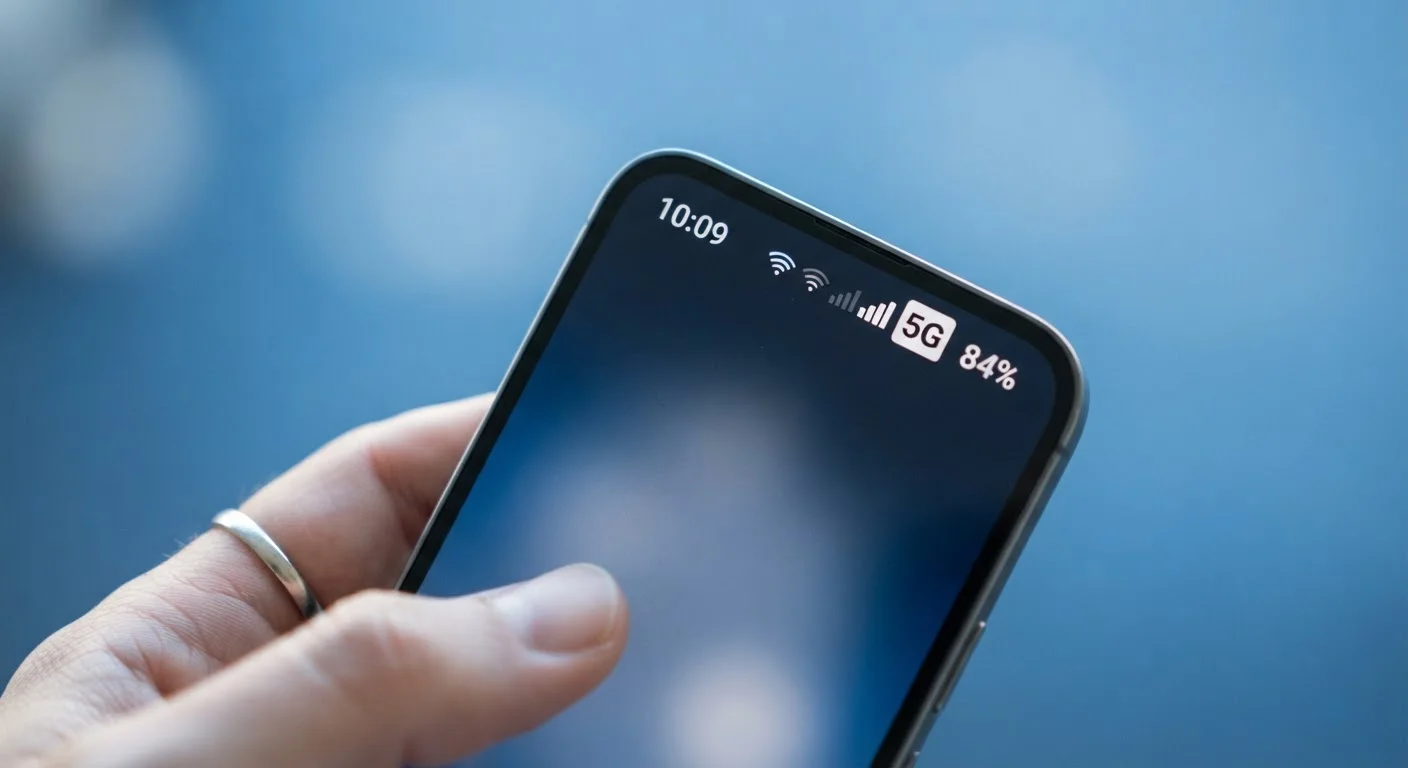
Photo: TheSearchHound.com | One Stop Answer To All Your Questions editorial
What the Labels Actually Mean
When your phone shows "LTE," "4G," or "5G" next to the signal bars, it is identifying which generation of mobile network technology your device is currently using. These labels come from standards set by international bodies - primarily the 3rd Generation Partnership Project (3GPP) and the International Telecommunication Union (ITU) - and each generation defines minimum requirements for speed, capacity, and reliability.
| 4G LTE typical download speed | 10-50 Mbps in real-world use (FCC Broadband Speed Guide (general reference)) |
| 5G theoretical peak speed | Up to 20 Gbps (lab conditions) (ITU IMT-2020 specification) |
| LTE latency (typical) | 30-50 milliseconds (Industry benchmark averages) |
| 5G Sub-6 latency (typical) | 10-20 milliseconds (3GPP Release 15 targets) |
| mmWave 5G range | Under 1,500 feet in open air (General radio propagation estimates) |
| U.S. 5G availability | Present in hundreds of cities; coverage depth varies widely (Major carrier public disclosures) |
4G and LTE are closely related. Technically, LTE (Long-Term Evolution) is the radio technology that delivers 4G service. When you see "LTE" on your status bar, you are on a 4G network. Some phones show "4G LTE" explicitly; others show just one label. Either way, you are on the same generation of network. For most people in the U.S., LTE remains the primary connection technology for the majority of the day, even on phones marketed as 5G-capable.
5G is the fifth generation, designed to carry more simultaneous connections, reduce latency, and - in specific conditions - deliver dramatically faster peak speeds. But 5G is not one uniform experience. The performance you get depends almost entirely on which part of the radio spectrum your carrier is using in your location. See the glossary below for definitions of the key spectrum terms.
Network Generation
A standardized phase of mobile network technology, such as 4G or 5G. Each generation defines a set of technical specifications for speed, latency, and capacity, agreed upon by international standards bodies.
LTE
Long-Term Evolution - the dominant 4G radio technology that most U.S. phones connect to. LTE-Advanced variants pushed 4G performance close to early 5G speeds in ideal conditions.
Latency
The time it takes for a data request to travel from your device to a server and back, measured in milliseconds. Lower latency means faster-feeling interactions, especially in video calls and gaming.
Spectrum Band
A range of radio frequencies licensed for wireless communication. Low-band spectrum covers large areas but carries less data; high-band (millimeter wave) carries enormous data but travels very short distances.
Millimeter Wave (mmWave)
A high-frequency 5G spectrum band that can deliver multi-gigabit speeds but is blocked by walls, windows, and even heavy rain. Mostly found in dense urban venues and stadiums.
Sub-6 GHz 5G
5G deployments using frequencies below 6 GHz. This band balances coverage area and speed, making it the backbone of most nationwide 5G networks in the United States.
The Spectrum Behind the Label
Every mobile network transmits data over radio waves, and the frequencies used determine the trade-off between coverage and speed. Understanding this is the key to making sense of what carriers actually deliver versus what their marketing implies.
- Low-band 5G (below ~1 GHz): Excellent geographic reach - signals travel far and penetrate buildings well. Real-world speeds are often only modestly faster than a strong LTE signal. This is the band powering most "nationwide 5G" coverage claims.
- Mid-band 5G (1-6 GHz, often called Sub-6): A meaningful step up in both speed and capacity, with reasonable building penetration. This band is increasingly common in populated areas and represents the most balanced 5G experience most users will encounter.
- mmWave 5G (24 GHz and above): Extremely fast in ideal conditions - multi-gigabit speeds are possible - but the signal degrades sharply over distance and cannot pass through most solid objects. Deployment is mostly limited to stadiums, airports, and dense urban street corridors.
The "5G" Label Can Mean Very Different Things
For a deeper look at how these speed numbers translate to real-world use, see our guide to Mbps, Gbps, and latency.
Coverage maps from carriers reflect which spectrum is available in a given area, but they often blend all three band types under a single color. Our article on why coverage maps look better than real life explains how to read them critically.
Does It Matter for What You Do Every Day?
For most everyday tasks - email, social media, navigation, streaming music - a solid LTE connection is functionally equivalent to low-band 5G. The difference becomes more meaningful in specific scenarios:
30-50 ms
Typical LTE latency
Real-world LTE latency commonly falls between 30 and 50 milliseconds, sufficient for streaming and most browsing but noticeable in competitive gaming.
10-20 ms
Typical Sub-6 5G latency
Sub-6 GHz 5G commonly cuts latency roughly in half compared to LTE, according to 3GPP Release 15 performance targets.
20 Gbps
5G peak theoretical throughput
The ITU's IMT-2020 spec sets a 20 Gbps peak - a lab ceiling that real-world deployments approach only under ideal millimeter wave conditions.
- Crowded venues: 5G's greater capacity means more users can share a network without performance collapsing at a concert or sports event. LTE often becomes congested in these settings.
- Large file downloads: On mid-band or mmWave 5G, downloading a large app update or video file can be noticeably faster - if the signal quality is there.
- Video calls and gaming: The latency reduction in 5G (especially mid-band) produces a more responsive experience, though most people would not find LTE latency unacceptable for casual use.
- Fixed Wireless Home Internet: Some carriers now use 5G (typically mid-band) to deliver home broadband. This is a distinct use case, explained further in our overview of broadband connection types.
The label on your status bar is a starting point, not the full picture. Checking your phone's network settings can sometimes reveal which specific band you are connected to, giving you a clearer read on actual performance expectations. For a full look at how phone hardware interacts with network performance, see our guide to phone specs that matter.
The content on this site is provided for informational purposes only and should not be considered a substitute for professional advice. While we strive to provide accurate and up-to-date information, we make no guarantees regarding its completeness or accuracy. Always consult a qualified professional for advice specific to your circumstances before making any decisions.