
Why Tailgating Is More Dangerous Than Most Drivers Realize

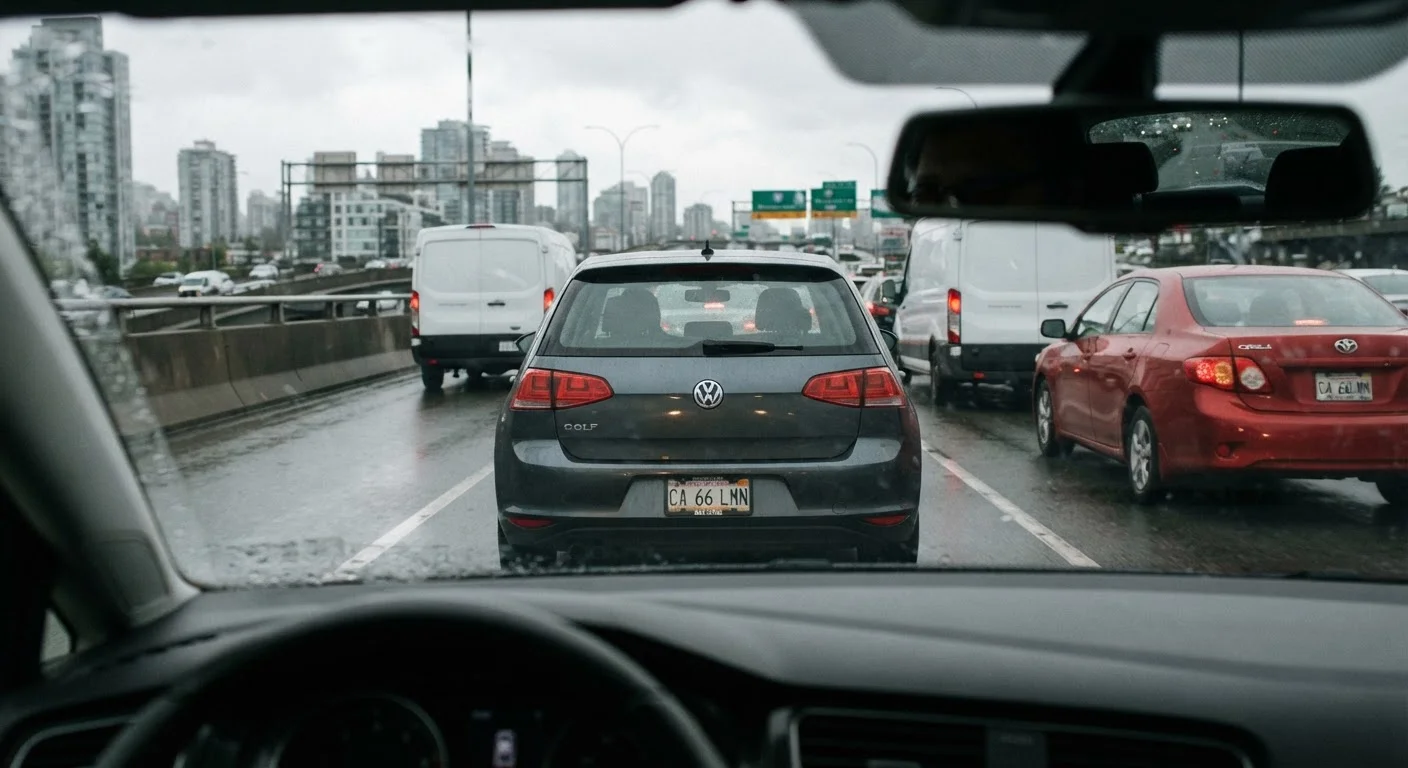
Photo: TheSearchHound.com | One Stop Answer To All Your Questions editorial
Key Takeaways
- Rear-end collisions are one of the most common crash types in the U.S., and following distance is a primary factor.
- At 60 mph, a car travels roughly 88 feet per second - leaving almost no margin when following too closely.
- The three-second rule provides a simple, speed-independent way to maintain a safe gap.
- Wet, icy, or uneven road surfaces significantly extend stopping distances and require even greater following distance.
- Tailgating is a form of aggressive driving and is illegal in every U.S. state.
The Physics of Following Distance
Most drivers understand, in a general way, that following too closely is risky. What many underestimate is exactly how little time they have to react when a hazard appears ahead of them.
At 60 mph, a vehicle covers 88 feet every second. By the time the average driver notices brake lights, decides to brake, and actually applies the pedal - a process that typically takes 1.5 seconds or more - the car has already traveled well over 100 feet. Braking then requires additional distance before the vehicle actually stops. Together, these factors mean total stopping distance at 60 mph can exceed 240 feet under dry, normal conditions.
When a driver is following just a car length or two behind, none of that math works in their favor. The buffer is gone before the foot even hits the brake. This is why common driving myths - like the idea that attentive drivers can stop fast enough at close range - deserve to be questioned with real data.
~2.5M
Rear-end crashes in the U.S. each year
The National Highway Traffic Safety Administration (NHTSA) has consistently identified rear-end collisions as one of the most frequent crash types on American roads.
240+ ft
Typical stopping distance at 60 mph
This estimate combines average reaction distance and braking distance under normal dry-road conditions for a passenger vehicle.
1.5 sec
Average driver perception-reaction time
Safety researchers commonly cite 1.5 seconds as the average time from perceiving a hazard to applying the brakes, during which the vehicle continues at full speed.
The Three-Second Rule and Why It Works
The three-second rule is the most practical and widely taught method for maintaining a safe following distance. It's speed-independent, meaning it scales automatically whether you're doing 35 mph on a city street or 70 mph on the interstate.
To apply it: choose a stationary reference point ahead - a sign, overpass, or lane marking. When the vehicle in front passes it, begin counting. If you reach that same point before counting to three, you're following too closely and need to ease back.
In adverse conditions, that baseline should increase. Rain, snow, ice, fog, or even gravel on the road surface all extend the distance a car needs to stop. Drivers hauling heavy loads, towing trailers, or driving older vehicles with less responsive brakes should add further margin. New drivers especially benefit from internalizing this rule early, before habits become automatic.
Increase Your Gap in Adverse Conditions
Tailgating as Aggressive Driving
Tailgating isn't always accidental. In many cases, it's a deliberate behavior - a way to pressure a slower driver to move over, or a product of frustration in heavy traffic. This places it squarely in the category of aggressive driving, a pattern that differs meaningfully from defensive driving in both intent and outcome.
Regardless of intent, the physical danger is the same: a driver who is tailgating has reduced their margin for error to nearly zero. If the lead vehicle brakes hard for a pedestrian, a pothole, or a sudden obstacle, a crash is almost unavoidable at close range.
There's also a chain-reaction risk. In multi-vehicle pileups, the initial rear-end impact often triggers a series of additional collisions as trailing vehicles have no time to stop. This is particularly dangerous on highways where speeds are high and traffic is dense. Building situational awareness means recognizing these dynamics before they become emergencies.
Practical Habits That Create More Space
Creating safer following distances is partly a matter of awareness and partly a matter of habits - some of which connect to broader vehicle health as well. For example, riding the brakes in heavy traffic not only increases brake wear but often signals that a driver isn't leaving enough gap to coast and slow naturally.
A few practical adjustments make consistent space management easier:
- Anticipate, don't react. Watch the traffic several cars ahead, not just the bumper directly in front of you. Early awareness gives more time to ease off the throttle gradually.
- Resist the urge to close gaps. When another vehicle merges into your following gap, ease back rather than accelerating to reclaim it. The gap exists for your safety, not to mark territory.
- Adjust for your vehicle's condition. Worn brake pads or tires with low tread - explored in depth in our guide to tire pressure and safety - extend stopping distances further than many drivers account for.
- Stay off the phone. Even glancing at a screen eliminates the reaction time that following distance is designed to preserve.
None of these habits require special training. They require only a deliberate shift in how you think about the space in front of your car - not as empty road to fill, but as the margin between a close call and a collision.
Frequently Asked Questions
The content on this site is provided for informational purposes only and should not be considered a substitute for professional advice. While we strive to provide accurate and up-to-date information, we make no guarantees regarding its completeness or accuracy. Always consult a qualified professional for advice specific to your circumstances before making any decisions.